
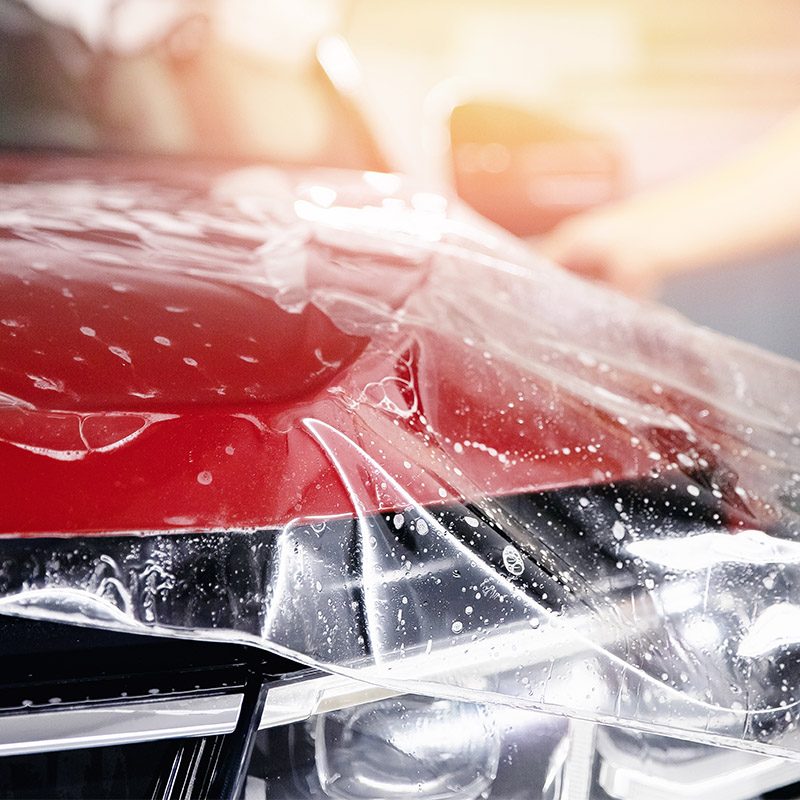
Tpu paint protection film for motorcycles is usually sold as the same product that goes on a car, simply cut smaller. That shortcut is the reason so many motorcycle installations look acceptable on the day and disappointing a season later. A motorcycle presents a different geometry, a different exposure profile and a different maintenance reality, and each of those changes what the film has to do.
This article sets out where the two applications genuinely diverge, and what a rider, a detailer or a film maker should change in the specification rather than in the cut pattern.
Geometry: Curves, Edges and Compound Surfaces
Car panels are large, gently curved and mostly convex. Motorcycle bodywork is the opposite: fairings have compound curves, tank shapes have tight radii and deep concavities, and the same panel often transitions from convex to concave within a hand span. Film has to stretch over some areas and relieve into others, often within the same piece.
That geometry changes the specification. A softer, more conformable film that would be considered too compliant for a large flat bonnet is genuinely useful on a fairing, because the installer can work it around tight details without heat and without stretching it so far that it thins and fails later. Conversely, a stiff film that performs well on a car door becomes a liability on a tank, where the edges will lift as the material fights against the surface.
What Tpu Paint Protection Film for Motorcycles Faces That Cars Do Not
- Higher impact energy on exposed surfaces. With less bodywork ahead of them, front fairings, headlight surrounds and leading edges take debris directly rather than behind a bumper.
- Vibration, not just impact. Continuous engine vibration works on film edges in a way that a car panel never experiences, which makes adhesive stability the deciding property.
- Fuel and chemical contact. Filling a tank inevitably spills a little, and some films that resist water perfectly will haze or lift when exposed to petrol.
- Rider contact and abrasion. Knees, boots and clothing rub against paint and film far more than in a car, at the same few points, repeatedly.
| Aspect | Car Application | Motorcycle Application |
|---|---|---|
| Panel geometry | Large, gently convex | Compound curves, tight radii, small panels |
| Preferred film character | Firmer, for impact and flat application | Softer and more conformable, for tight detail work |
| Edge stress | Thermal movement and washing | Continuous vibration plus rider contact |
| Chemical exposure | Fuel drips at the filler, road salts | Regular fuel contact on the tank, chain lubricant |
| Typical service window | Long, on large low-stress panels | Shorter on contact areas; expect partial renewal |
The last row is the one installers should discuss with the customer before taking a deposit. On a motorcycle, partial renewal of the contact areas is normal rather than a defect, and setting that expectation in advance prevents a complaint that the film did not last as long as it did on a car.
Adhesive Stability Is the Deciding Property
On a car, film failure usually starts with an impact that cuts through the material. On a motorcycle, it usually starts at an edge, where vibration and rider contact gradually work the adhesive loose. That shifts the priority from impact resistance alone to how well the adhesive holds to the specific paint system in use, and how well it resists creep under constant small loads.
This is why two films with identical thickness and similar clarity can behave completely differently on the same bike. The difference is in the adhesive formulation and in how the edge was finished. Anyone specifying film for motorcycles should treat the adhesive system as a first-class specification item rather than assuming it comes as part of the package.
Motorcycle-specific specification priorities:
• Conformability first, because the geometry demands it.
• Adhesive stability under vibration, tested rather than assumed.
• Resistance to petrol and chain lubricant at the points where they land.
• A realistic renewal plan for knee and boot contact areas.
Application Discipline on a Motorcycle
Most motorcycles are installed with the panels removed and laid flat on a bench, and that changes the practical workflow compared with a car. The advantage is access and control; the risk is that a panel which looks flat on a bench is still a compound curve in three dimensions, and film applied in one orientation may not release around the far edge.
The sequence below reflects the order that experienced installers tend to follow, and the reasoning behind each step is worth understanding rather than copying.
- Decontaminate, then check for previous coatings. A panel with a coating or a glaze underneath needs a different preparation route, and applying film over an unknown layer is how paint damage complaints begin.
- Plan the piece layout on the panel. Decide which edges will be wrapped and which will be trimmed, because a wrapped edge holds far better under vibration.
- Work from the tightest radius outward. Setting the difficult geometry while the film is still fully movable prevents trapped stress at the details.
- Post-heat the edges. A controlled warm cycle settles the adhesive and is the single step most often skipped in a hurry, with the predictable consequence.
Installers who photograph the finished edges and record the post-heat temperature also build a useful record for themselves, because edge lifting claims can then be traced to a specific panel on a specific day rather than argued about in general terms.
There is also a commercial argument for cutting patterns properly rather than freehand. A pattern library built around the models a workshop actually sees turns a two-hour installation into a predictable one, and it removes the variation that makes a quotation unreliable. On sports bikes with many closely related fairing variants, the pattern notes matter almost as much as the film choice, because a panel that is a few millimetres different will produce an edge in the wrong place and a lift claim next season. Building that library is unglamorous work, but it is the difference between a workshop that installs film occasionally and one that can quote motorcycle protection as a standard service.
Choosing the Film With the Manufacturer
Conformability and adhesive behaviour are formulated properties, so the useful conversation is with the film maker. Zhejiang Huanlong has manufactured functional films since 2007 across three production bases in Zhejiang, with blown film, extrusion and foaming lines, two research centres and more than thirty engineers, which allows a protection film to be tuned for motorcycle geometry rather than adapted from a car grade.
Our automotive and powersport protection material is described on the tpu paint protection film page, and the product specification for the automotive range sits under automotive paint protection film. Tell a Huanlong engineer which panels and which paint system you are working with, and the film can be matched to the geometry instead of to a template.
Frequently Asked Questions About Tpu Paint Protection Film for Motorcycles
Q1. Can car film be used on a motorcycle?
It can be applied, but it is usually the wrong compromise. A firmer film that suits flat car panels is harder to work around fairing details, and the resulting stress at the edges is exactly where motorcycle film fails first. Ask for a more conformable grade instead of accepting the car product by default.
Q2. Will fuel spills damage the film on a tank?
Resistance to petrol varies significantly between grades, and it is a legitimate question to ask before installation. Even a resistant film benefits from being wiped promptly rather than left wet, and some installers plan a replaceable patch around the filler area for exactly this reason.
Q3. How long should motorcycle film last?
Expect a shorter life on the panels that take rider contact and continuous vibration than on a low-stress car panel. Planning for partial renewal of the knee and boot areas is more realistic than expecting the whole installation to age uniformly.
Q4. Does film hide existing scratches?
It can soften the appearance of very fine marks, but it does not fill scratches and it will not disguise damage in the paint beneath. On a used bike, address the paint first and then decide, because film applied over a poor surface tends to make the defect more visible rather than less.
Q5. What should a buyer ask the film supplier?
Ask for the polymer family, the adhesive type, the recommended post-heat temperature and the certifications held. Zhejiang Huanlong is certified to OEKO-TEX® 100, Bluesign®, GRS and ISO 9001:2015 alongside ISO 14001 and ISO 45001. Where a customer requires additional test standards, ask for the report rather than a verbal assurance.
A motorcycle is a harder case than a car for any film, because the geometry is tighter, the vibration never stops and the rider touches the surface constantly. Treat those three facts as specification inputs rather than as surprises, and tpu paint protection film for motorcycles will perform to the standard a rider actually expects.