
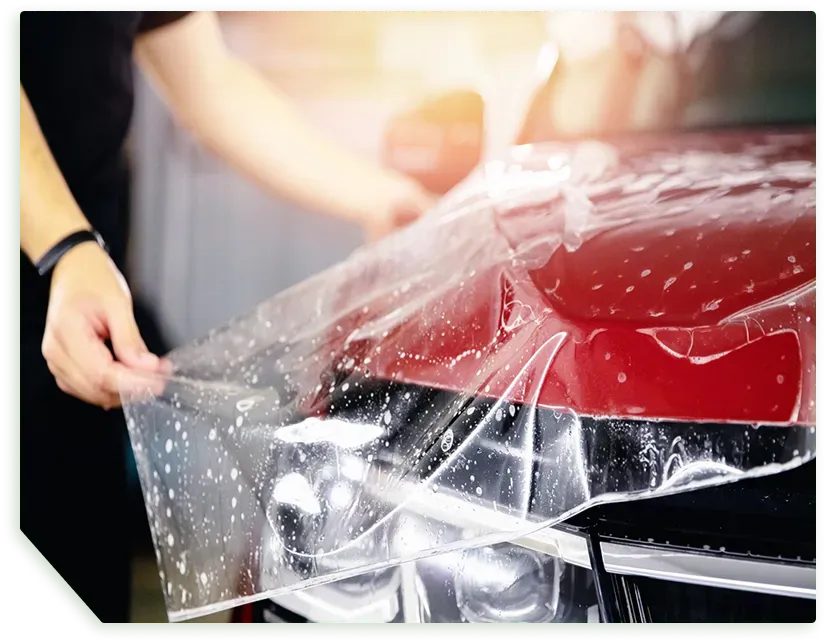
Tpu paint protection film vs ceramic coating is one of the most confused comparisons in the automotive aftermarket, largely because both products are marketed as protection and both make a paint surface easier to clean. They are not competing versions of the same thing. One is a physical film that absorbs energy; the other is a chemical layer that changes surface behaviour.
Understanding the difference matters because the two are often sold as substitutes when they are in fact complementary, and because the failure a customer complains about usually reveals which one they actually needed.
Two Different Jobs on the Same Panel
A paint protection film is a thermoplastic polyurethane sheet with an adhesive backing, typically a few tens of micrometres thick, applied to the painted surface. It works by absorbing impact energy and by providing a sacrificial layer that can be replaced. Stone chips, road debris and light abrasion are its target threats, and its performance is measured in terms of impact resistance, self-healing behaviour and optical clarity.
A ceramic coating is a liquid-applied layer, usually a silicon-based chemistry, that bonds to the paint and creates a hydrophobic, high-contact-angle surface. It does not absorb impact in any meaningful way. Its strengths are chemical resistance, water beading, dirt release and gloss retention, and it is applied in a thickness measured in fractions of a micrometre.
Where Tpu Paint Protection Film Vs Ceramic Coating Actually Differ
- Impact and stone chips. The film absorbs and disperses energy; a coating offers effectively no protection here and cannot prevent a chip from reaching the paint.
- UV and oxidation. Both address ultraviolet exposure, but through different mechanisms, and the durability of the effect depends on formulation and on reapplication cycles rather than on a single number.
- Swirl marks and wash marring. A coating reduces the friction of washing and therefore the rate at which marring appears; a film physically separates the wash media from the paint.
- Reversibility. Film can be removed and replaced, restoring the panel to its original condition. A coating is consumed over time and removed only by polishing or abrasion.
| Threat | TPU Film | Ceramic Coating |
|---|---|---|
| Stone chips from road debris | Primary defence; energy absorbed in the film | Minimal effect on impact |
| Wash-induced swirl marks | Blocks contact; the film takes the marring | Reduces friction and marring rate |
| Bird droppings and tree sap | Contaminant sits on a replaceable layer | Strong chemical resistance; easier removal |
| Light scratches and scuffs | Self-healing topcoat recovers with heat | No self-healing; scratches remain |
| Cost of refresh over ten years | Replacement of worn panels, not of the whole car | Periodic reapplication and topping up |
Read across the rows and the logic becomes obvious: neither column is redundant. The film handles the mechanical threats and the coating handles the chemical and cleaning ones, which is why serious detailing programmes frequently use both.
Why the Comparison Is Framed as a Choice
The two products are often presented as alternatives because they are sold through the same channel and to the same customer, and because price points overlap at the entry level. A low-grade film and a premium coating can cost similar amounts, which invites a comparison that ignores what each actually does.
The more useful framing is to ask what the customer is trying to prevent. A daily highway commuter is exposed to stone chips and needs film on the front of the vehicle. A collector car that is washed weekly and rarely driven fast has a different exposure profile where a coating may deliver most of the benefit for less money. The question is not which product is better in general, but which threat dominates the use case.
A straightforward way to decide:
• High-speed road use and stone exposure, then film comes first.
• Frequent washing and chemical fallout, then a coating earns its cost.
• A new car held long term, then film on impact areas plus a coating elsewhere.
• A leased car returned in three years, then weigh the residual effect honestly.
Specifying the Film Side Properly
Where film is the right answer, the specification decides whether the customer notices. Three properties carry most of the experience: optical clarity, which determines whether the film is visible on a dark paint surface; self-healing behaviour, which determines how the surface recovers from light contact; and adhesive stability, which determines whether the film lifts at an edge two summers later.
The base polymer matters here. Aliphatic polyurethane chemistry is generally chosen for exterior paint protection because it resists yellowing better than aromatic alternatives, and the difference only becomes obvious after a couple of years of sunlight. That is a specification decision made at purchase that a customer cannot reverse, which is why it should be asked about explicitly rather than inferred from a price.
Questions Worth Asking Before Buying Either
Both product categories contain a wide range of quality, and both are frequently sold on brand rather than on evidence. The four questions below separate a considered recommendation from a sales pitch.
- What exactly is being applied, and who makes it? A named film construction or coating chemistry is a meaningful answer; a brand name alone is not.
- What is the removal route? For film, ask how it comes off and who pays if paint is affected. For a coating, ask how it is refreshed.
- Which panels are actually covered? Partial coverage with visible edges can look worse than no coverage, so the panel list should be agreed in writing.
- What is the warranty, and who honours it? A manufacturer warranty and an installer warranty cover different things, and the customer should know which is which.
Installers who can answer those four questions without hesitation are usually working with material they understand. Those who cannot are usually reselling whatever arrived last week, which is a risk that shows up at the first removal.
One further distinction is worth holding on to. Film protection is still doing its job on the day the car is sold, because a removable layer that has taken the chips is a demonstrable absence of damage underneath. A coating's contribution is cumulative and invisible: it made the washing easier and the surface cleaner for a period of years, and once it has worn away the evidence goes with it. If resale presentation matters, that asymmetry usually favours putting the money into film on the panels that take the punishment.
Where the Film Comes From
Paint protection film is a formulated product, not a commodity, so the specification conversation belongs with the film manufacturer. Zhejiang Huanlong has produced functional films since 2007 across three production bases in Zhejiang, with blown film, extrusion and foaming lines, two research centres and more than thirty engineers, which allows a protection film programme to be developed against a vehicle type rather than against a generic grade.
Our automotive protection range is described on the tpu paint protection film page, and the corresponding product specification sits under automotive paint protection film. A Huanlong engineer can also advise on which panels benefit most from film and where a coating is the better spend, which is a more useful answer than selling both everywhere.
Frequently Asked Questions About Tpu Paint Protection Film Vs Ceramic Coating
Q1. Can a ceramic coating be applied over a paint protection film?
Yes, and it is a common combination because the coating improves the film's cleaning behaviour and water shedding. It should only be applied once the film has fully settled, and with a coating formulated for use on a flexible substrate rather than on paint alone. Ask the installer which product they intend to use on top of the film and why.
Q2. Which one protects against stone chips better?
Film, decisively. A coating has no meaningful capacity to absorb impact energy, so a stone at motorway speed will reach the paint regardless of the coating on top. Any claim to the contrary is a marketing statement rather than a materials property.
Q3. Does film prevent the paint from fading in sunlight?
A film with appropriate ultraviolet stabilisation reduces the exposure reaching the paint, which helps slow oxidation and fading. The magnitude depends on the formulation, and any number quoted should come with the test method behind it. Where the film itself yellows, the cause is usually the base polymer chemistry rather than the stabiliser package.
Q4. Is it worth putting film on a leased car?
It can be, if the lease contract allows film and if the return condition standards penalise paint damage. Read the contract first, then decide. A film that has to be removed before return adds a cost, so the calculation is not the same as it is for an owned vehicle.
Q5. What should an installer disclose about the film they use?
The film construction, the polymer family, the expected service life and the removal method. Zhejiang Huanlong holds OEKO-TEX® 100, Bluesign®, GRS and ISO 9001:2015 along with ISO 14001 and ISO 45001, so a buyer can verify the manufacturer's compliance position directly rather than relying on a reseller's description.
The honest conclusion is that a film and a coating solve different problems, and the customer who understands which threat they face gets better value from either. Decide on impact exposure first, chemical and cleaning exposure second, and treat tpu paint protection film vs ceramic coating as a question about the use case rather than about product superiority.