
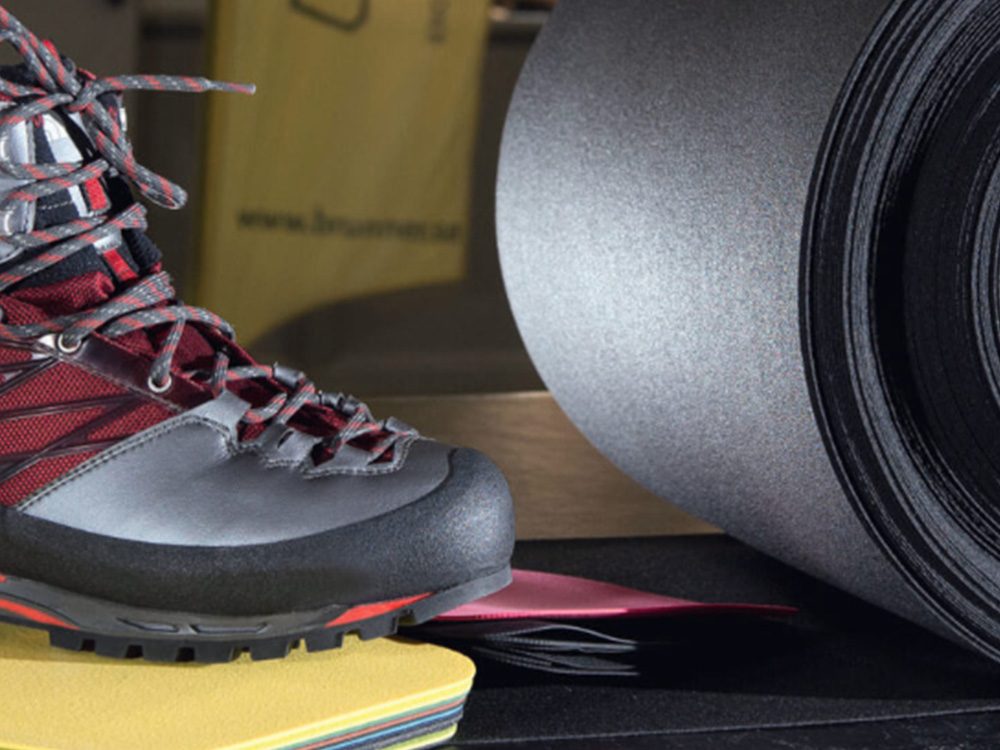
Tpu hot melt adhesive film for footwear is the quiet change that happens when a factory moves from cementing by hand to bonding by heat and pressure. The swap looks like a materials decision, but it is really a process decision: it removes solvent from the building, moves the bond quality from operator skill to machine settings, and changes the scrap profile of the whole line.
This article sets out where a hot melt film genuinely beats a solvent cement at volume, where it does not, and what a footwear team should measure before replacing a process that the factory already understands.
What Changed to Make Film Bonding Viable in Footwear
Solvent cements dominated footwear assembly for decades because they tolerate imperfect surfaces and forgiving cycle times. Their weakness is the same as their strength: the process depends on the person applying it. Flash-off windows vary with humidity, coating weight varies with the brush, and the difference between a good bond and a marginal one is invisible until the shoe is worn.
Hot melt film changes the equation by moving the adhesive into a pre-formed sheet with a defined weight and a defined activation temperature. The bond is produced by heat and pressure under a controlled press cycle, so the variables that used to live in the operator's hands now live in a recipe. Where a factory has already invested in automated presses and is under pressure to reduce volatile emissions, that shift pays for itself.
Where Tpu Hot Melt Adhesive Film for Footwear Earns Its Place
- Repeatability at volume. A film delivers the same adhesive weight on every part, which is the single largest source of bond variation removed from the line.
- No solvent handling. Ventilation, storage, personal protective equipment and volatile emission reporting all change when the adhesive arrives as a solid.
- Cleaner factory environment. Overspray, drips and contaminated workstations disappear, and rework caused by cement staining falls with them.
- Flexible bond lines. A TPU carrier keeps the joint flexible in service, which matters on athletic constructions that bend through the sole thousands of times.
| Assembly Step | Solvent Cement Route | Film Route |
|---|---|---|
| Adhesive application | Brush or spray, weight varies with operator | Pre-formed sheet, weight fixed per part |
| Open time management | Humidity and temperature sensitive window | Activation by press cycle, repeatable |
| Ventilation and storage | Extraction, drum storage, safety procedures | Dry roll storage, no extraction required at the bond point |
| Rework profile | Staining and solvent damage often scrap the part | Heat reactivation allows a second attempt |
| Bond consistency | Depends on operator skill and shift | Set by press parameters and verified by peel test |
The last row is the one that decides the business case. Bond consistency is what a brand actually buys, and it is the parameter a film process can hold across three shifts and several lines.
Honest Limits of the Film Route
Film bonding is not a universal replacement. It needs pressure, temperature and time to be applied evenly across the bond line, which means the tooling has to suit the geometry of the part. Deep three-dimensional assemblies with undercuts are harder to press than flat panels, and small workshops without presses will find the change disruptive rather than liberating.
Surface condition also still matters. Release agents, mould contamination and silicone residues prevent a film bond exactly as they prevent a cement bond, and a factory that has learned to live with imperfect preparation will carry that habit into the new process and blame the material. Preparation discipline is not removed by the change; it is only made more visible.
Before switching a footwear line from cement to film:
• Confirm press capacity and even pressure across the bond area.
• Establish a peel test on every shift, at a fixed rate and angle.
• Audit substrate preparation, especially on rubber and foamed midsoles.
• Run a full seasonal style through both routes before retiring the old one.
What to Measure During a Conversion Trial
A conversion trial that produces a good-looking shoe proves very little. The measurements below are the ones that predict whether the process holds after the trial team has left the building.
- Peel strength on production parts. Measure the finished shoe, not a laboratory plaque, because press pressure on a real last differs from a flat platen.
- Cycle time and takt. Film bonding can be faster or slower than cementing depending on how the press is loaded. Measure both before assuming an improvement.
- Flex and ageing performance. Run a flex test plus a warm humid ageing cycle, because the failure that matters usually appears a season later in a warm climate.
- Scrap and rework rate. Track them for a full week of production rather than a single shift, since the two routes fail in different patterns.
Factories that run those four measurements usually reach a decision within one style cycle, and the decision is defensible to a brand customer who will ask how the bond was validated. That defensibility is worth as much as the material saving, because it is what allows the factory to quote on higher-value work.
Specifying the Film Itself
Three properties decide most of the outcome. Activation temperature sets the press window and therefore the cycle time. Melt flow behaviour determines whether the adhesive can wet a textured surface before it sets. Carrier thickness controls how much adhesive is available and how much gap the film can bridge between two irregular surfaces. Get those three right and the rest of the specification follows.
It is also worth checking how the film behaves on a second pass through the press. Some constructions tolerate reactivation cleanly, which gives the factory a genuine rework route on an expensive upper. Others degrade and must be stripped. If rework matters to your cost model, make it part of the sample evaluation rather than an afterthought.
Working With the Film Manufacturer
Hot melt film is formulated for a temperature window and a substrate family, so the specification conversation belongs with the maker. Zhejiang Huanlong has produced functional films since 2007 across three production bases in Zhejiang, with blown film, extrusion and foaming lines, two research centres and more than thirty engineers. A footwear programme can therefore be developed against the actual press parameters rather than against a general purpose grade.
Our adhesive film range is described on the tpu hot melt adhesive film page, and an example of lightweight film construction in work footwear is documented in the TPU foam film for work footwear project note. A Huanlong engineer can also advise on the press parameters that suit an existing line, which is usually the fastest way to shorten a conversion trial.
Frequently Asked Questions About Tpu Hot Melt Adhesive Film for Footwear
Q1. Can hot melt film bond rubber outsoles as well as solvent cement does?
It can, but rubber needs more preparation than most other substrates because mould release agents and antiozonants sit on the surface. If the bond line is properly abraded or primed, film performance is comparable and more consistent. Skipping that step is the most common cause of a disappointing first trial.
Q2. Does the film route remove the need for a primer entirely?
Not always. On many substrates the film bonds directly, which is a real simplification worth having. On low surface energy materials or heavily contaminated mouldings a primer or a surface treatment may still be required. Ask for the substrate list the grade was validated on rather than assuming broad compatibility.
Q3. How does a film bond perform after repeated flexing in wear?
Because the adhesive is a thermoplastic polyurethane rather than a rigid cured resin, the joint remains flexible and follows the movement of the upper instead of cracking behind it. Flex crack resistance still has to be verified on the actual construction, since the number depends on thickness, radius and temperature together.
Q4. What certifications should a footwear brand ask about?
Ask what the manufacturer actually holds. Zhejiang Huanlong is certified to OEKO-TEX® 100, Bluesign®, GRS and ISO 9001:2015, together with ISO 14001 and ISO 45001. Where a brand requires additional test standards for restricted substances, request test reports for the specific batch rather than relying on a general statement.
Q5. Is the film route cheaper per pair than cementing?
The material cost per pair is usually higher and the process cost is usually lower, so the answer depends on labour rates, scrap rates and press utilisation in your factory. Model it on a full style with your own numbers instead of accepting a general claim in either direction.
Footwear assembly is a volume business, and volume punishes variability. The reason the film route keeps winning specifications is not that it produces a better bond on a good day, but that it produces the same bond on an ordinary one. Measure the four things that matter, run a full style through both routes, and tpu hot melt adhesive film for footwear will justify the change on its own numbers.