
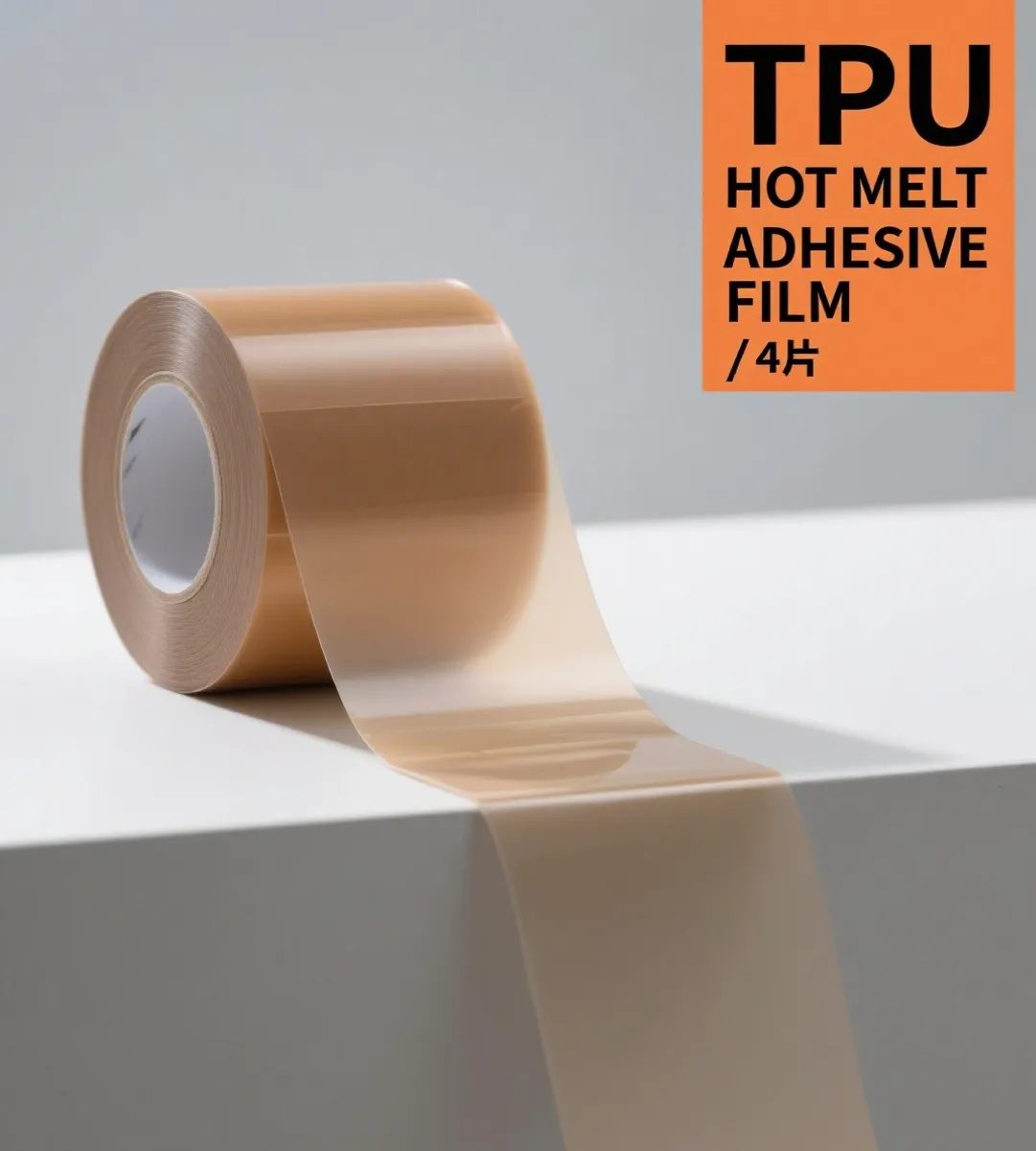
Tpu hot melt adhesive film for heat transfer printing is the layer that decides whether a graphic survives fifty home washes or peels at the corner after ten. Brands spend heavily on the print itself, then discover that the weak point was never the ink. It was the adhesive, and the difference between a good and a bad choice only shows up after the garment has been through a hot wash cycle several times.
This article looks at how a hot melt adhesive film behaves through repeated laundering, what a transfer designer should specify, and which failures are actually material problems rather than press-setting problems.
Why Wash Durability Is an Adhesive Question
A heat transfer is a stack: carrier, ink, adhesive, fabric. During a wash cycle that stack is repeatedly heated, wetted, flexed and dried. The fabric swells and shrinks. Detergents change the surface chemistry of the fibre. Mechanical action works the perimeter of the graphic, which is where every failure starts. An adhesive has to accommodate all of that while remaining flexible enough not to crack and elastic enough not to creep.
Thermoplastic polyurethane is suited to the job because it can be formulated to sit between the two failure modes. It softens enough during pressing to flow into the weave, then sets into a film that follows the fabric rather than fighting it. That balance is why adhesive film selection changes wash performance more than incremental improvements to the ink layer usually do.
What Tpu Hot Melt Adhesive Film for Heat Transfer Printing Must Handle
- Repeated thermal cycling. Each wash and tumble cycle reheats the bond, so the adhesive must resist creep rather than simply melting and re-setting.
- Detergent and softener chemistry. Surfactants and fabric conditioners attack the bond line over time, which is why a short soak test is a poor predictor of a hundred washes.
- Fabric movement. Knitted garments stretch in service and elastic fabrics move even more, so the adhesive has to elongate with the substrate.
- Edge stress. Failures almost always begin at the perimeter, where the concentration of load is highest and where a slightly thin adhesive coat is most damaging.
| Failure Observed | Most Likely Cause | First Thing to Change |
|---|---|---|
| Edge lifting after a few washes | Adhesive too thin at the perimeter or press pressure uneven | Adhesive weight per unit area and platen flatness |
| Cracking across the graphic | Adhesive too hard for the fabric's elongation | Softer grade, or a thinner film on stretch fabric |
| Complete detachment after drying | Contamination, fabric finish or insufficient dwell time | Substrate preparation and press recipe |
| Yellowing or hazing of the transfer | Excessive press temperature or a heat-sensitive carrier | Temperature and dwell, then the carrier specification |
| Stiff patch feeling on the garment | Adhesive layer thicker than the application needs | Lower film weight or a softer grade at the same weight |
That table is useful because it separates material causes from process causes. In our experience roughly half the wash failures reported against an adhesive were actually press-setting problems, and half the process problems were caused by a grade chosen for the wrong fabric.
Matching the Grade to the Fabric, Not the Print
The single most useful specification decision is to select the adhesive against the substrate rather than against the artwork. A cotton shirt and a polyester sports jersey behave completely differently in a wash. Cotton swells, holds water and dries slowly; polyester wicks and dries fast but has a low surface energy that resists bonding unless the adhesive is formulated for it.
Blends sit between the two and are the most common source of surprising results, because a 60/40 blend can behave more like one fibre than the other depending on the finish applied at the mill. Ask the fabric supplier for the finish information before choosing a grade. A silicone softener applied for hand feel is a legitimate product decision that will quietly destroy transfer adhesion if nobody tells the transfer team about it.
A wash-durable transfer programme depends on:
• A grade chosen for the fibre and finish, not for the artwork.
• A press recipe validated with a peel test, not with a visual check.
• A defined wash test protocol agreed with the brand before production.
• Traceability from film batch to finished garment.
How to Test Wash Durability Properly
Most wash tests are run too briefly to differentiate between two candidate adhesives, which is why two grades can both pass and then behave differently in the market. The sequence below produces a result that separates them.
- Use the same fabric for every candidate. Comparing grades on different substrates measures the fabric, not the adhesive.
- Run a realistic cycle count. Ten washes will not separate two decent grades. Extend the protocol well beyond the brand's claim so the ranking is visible.
- Include detergent and softener. Water alone is a gentle test and will flatter a grade that fails in a real household regime.
- Assess the perimeter, not the centre. Photograph the edges at fixed intervals, because that is where the ranking appears first and most clearly.
Run that protocol once and the shortlist usually collapses to a single grade. It also produces the evidence a brand buyer will ask for when they query the wash claim on a specification sheet, which is often the point of running the test at all.
Keep a reference sample from the first approved batch and store it with the protocol. When a complaint arrives eighteen months later, the reference tells you within an hour whether the material changed or the process did. Without it, every complaint turns into an argument between supplier, printer and laundry, and the resolution costs more than the garments ever did. That kind of traceability is not bureaucracy; on apparel programmes it is the cheapest insurance available.
Getting the Film Right With the Manufacturer
Adhesive films are formulated around activation temperature, melt flow and substrate family, so the specification is a manufacturing conversation. Zhejiang Huanlong has manufactured functional films since 2007 across three production bases in Zhejiang, with blown film, extrusion and foaming lines, two research centres and more than thirty engineers. A transfer programme can therefore be matched to the fibre the brand actually uses rather than to a generic grade.
The adhesive range is described on the tpu hot melt adhesive film page, and the material set used by apparel converters sits under film solutions. If you send us the fibre, the finish and the brand's wash protocol, a Huanlong engineer can propose a grade and an activation window that will hold through the cycle count the market expects, and will say plainly when a substrate needs a different route instead.
Frequently Asked Questions About Tpu Hot Melt Adhesive Film for Heat Transfer Printing
Q1. How many washes can a TPU adhesive transfer realistically survive?
That depends more on the fabric and the washing regime than on the film alone. On a well-prepared cotton garment washed at moderate temperature, a correctly specified grade will comfortably exceed any commercial wash claim. On a stretch synthetic with a silicone finish, the same film will struggle. Define the substrate and the regime before quoting a number.
Q2. Does a thicker adhesive film always mean better durability?
No. Above a certain weight the adhesive adds stiffness and can trap solvent or moisture, which harms performance. The useful range is set by how irregular the fabric surface is, and a thin film on a smooth knit often outperforms a heavy film on the same substrate.
Q3. Can the same grade be used on cotton and polyester?
Sometimes, if the press parameters are re-tuned and the polyester has not been given a repellent finish. Because polyester has a lower surface energy, the activation window is narrower and the peel test becomes essential. Many factories keep two grades for exactly this reason.
Q4. What press parameters matter most?
Temperature, pressure and dwell time interact, and changing one usually requires adjusting the others. The most common error is raising temperature to compensate for insufficient pressure, which can yellow the carrier and still leave a weak bond. Set pressure first, then temperature, then dwell.
Q5. Which certifications should a brand check for apparel transfers?
For textile contact applications the relevant holding is OEKO-TEX® 100, which Zhejiang Huanlong holds alongside Bluesign®, GRS and ISO 9001:2015, ISO 14001 and ISO 45001. Where a brand requires additional restricted substance testing, ask for a batch-specific report rather than a general statement of compliance.
A transfer that survives the wash is not the result of a clever ink or a lucky press setting. It is the result of matching a grade to a specific fibre, a specific finish and a specific laundry regime, then proving it with a test long enough to separate the shortlist. Do that once and the wash claim stops being a risk, which is how tpu hot melt adhesive film for heat transfer printing turns laundry performance into a selling point.