
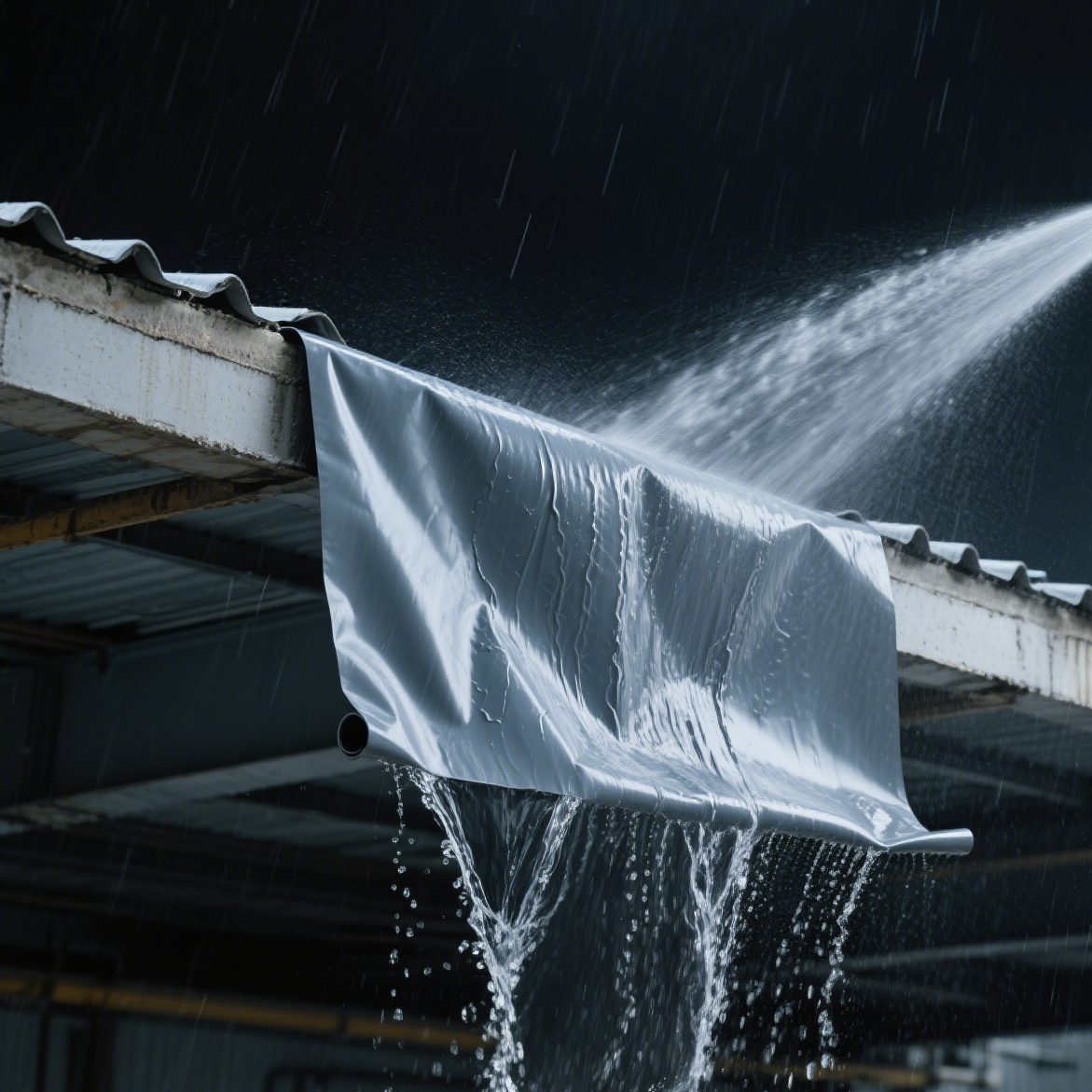
Tpu roof membrane installation is where a good specification is either realised or wasted. The membrane arrives as rolls and pre-fabricated panels, and from that point the outcome depends on substrate preparation, seam discipline, weather window management and the training of the crew holding the hot air welder.
This article sets out what a TPU membrane programme actually requires on site, where the labour content sits, and how fabricators and contractors should divide the work so that the difficult geometry is made indoors and the simple work is done outdoors.
Before the First Roll Is Opened
Most installation problems are created before the membrane is unrolled. The deck has to be clean, dry, structurally sound and free of anything that can puncture from below. Insulation boards must be fixed to a pattern that prevents movement under foot traffic, because a membrane laid over a moving substrate will show every deflection as a stress line within a season.
Layout matters just as much. Panel direction, seam spacing and the position of factory-made details should be planned on a drawing before mobilisation, not decided on the roof. A layout that keeps seams out of the drainage path and away from high-traffic routes will still look correct after five years of thermal cycling, which is a longer test than any site inspection applies.
What TPU Roof Membrane Installation Asks of the Crew
- Welder control. The processing window is narrower than with a polyolefin membrane, so speed, temperature and pressure have to be held deliberately rather than approximated.
- Handling discipline. Membrane rolls are heavy and the surface is easy to contaminate. Clean gloves, clean boots and a defined walking route protect the bond line.
- Weather monitoring. Moisture at the seam is the enemy of every thermoplastic weld, so dew point and surface temperature have to be checked rather than assumed.
- Seam testing as production, not inspection. Test welds at the start of each shift and a peel sample at intervals through the day.
| Stage | Responsible Party | Common Failure If Skipped |
|---|---|---|
| Deck survey and layout drawing | Contractor | Seams land in the drainage path; ponding and premature wear |
| Factory pre-fabrication of details | Fabricator | Hand-made corners that fail first |
| Substrate preparation | Contractor | Punctures and blisters from trapped debris or moisture |
| Field welding | Contractor | Cold welds that pass visual inspection and fail in a storm |
| Terminations and penetrations | Both, with supplier detail drawings | Water tracking behind the membrane at parapets |
The table shows why the fabricator is not optional. Details made in a factory with controlled temperature and trained operators are simply better than details made on a roof in a wind, and the cost difference is usually smaller than the repair cost of one failed corner.
The Seam Procedure Is the Quality System
On a thermoplastic roof, the seam procedure is the quality system. Everything else is preparation. A written procedure that specifies equipment settings, travel speed, overlap width and test frequency converts welding from a craft into a controlled process, and it is the single document that most improves the odds of a long-lived roof.
Test welds should be taken at the start of each shift and whenever ambient conditions change materially, and the samples should be labelled and retained. A documented seam test that passes is worth more than a visual inspection that looks right, because a cold weld looks identical to a correct one until it is pulled apart. Retaining the samples also gives the contractor a defensible position if a claim arrives two winters later.
A seam procedure that survives a real project usually contains the same four elements, and each one exists because its absence has caused failures before.
- Named equipment and settings. Model, nozzle, temperature, air volume, speed and roller pressure, written down rather than remembered.
- A measurable test. Peeling a sample by hand is a habit; peeling to a stated width at a stated rate is a result you can record and trend.
- A stated frequency. Shift start, after any break longer than an hour, and after any change in weather, machine or operator.
- An action on failure. A defined response that stops work on that seam until the setting is corrected and a passing sample is produced.
Every TPU roof should leave site with:
• A welding procedure that names settings and speeds.
• Labelled seam test samples retained for the project file.
• A record of ambient and surface conditions at each shift start.
• Photographs of every completed detail before the next trade follows.
Weather Windows and Site Programming
Thermoplastic welding is sensitive to moisture, which means the practical constraint is not rainfall but dew point. A roof that is visibly dry can still be unfit for welding if its surface temperature is at or below the dew point, and crews who weld through that condition produce seams that pass on the day and separate within a year.
That has programming consequences. Work should be planned in areas large enough to be completed within a stable weather window rather than started across an entire deck at once, and the membrane should be laid and welded in the same phase so that openness to rain is limited to hours rather than days. Contractors who schedule this way rarely have weather claims, because the risk was designed out rather than argued about afterwards.
Training belongs in the same planning conversation. A crew that has welded a polyolefin membrane for years is not automatically qualified on TPU, because the window is narrower and the reaction to a wrong setting is less forgiving. A short factory-run training session at the start of a programme costs a day and typically saves several site days of rework, which is why suppliers who care about installed performance offer it.
Handover documentation is not paperwork for its own sake. A roof that changes owner, or that is inspected by a new facilities team five years later, is far easier to maintain when the seam record, the layout drawing and the retained samples are all in one file. That file is also the fastest way to demonstrate that an installation was carried out to a defined procedure, which matters at the moment a warranty is discussed.
Working With the Film Manufacturer
Installation quality starts with a base film designed for lamination and welding, so the conversation belongs upstream of the contractor. Zhejiang Huanlong has made functional films since 2007 across three production bases in Zhejiang, with blown film, extrusion and foaming lines, two research centres and more than thirty engineers, which means a membrane base film can be tuned to the welding process a fabricator actually uses.
Our roofing material is described on the tpu roof membrane page, and its use as a base film laminated to fabric is documented in the roofing and building structures project note. A Huanlong engineer can also review a proposed seam procedure before mobilisation, which is the cheapest moment to discover that an intended setting sits outside the material's window.
Frequently Asked Questions About Tpu Roof Membrane Installation
Q1. Can a TPU membrane be installed in winter?
Its flexibility at low temperature is an advantage over polyolefin membranes, so handling and conforming to detail are easier in cold weather. Welding still requires a dry substrate and a surface temperature above the dew point, so winter work is a programming question rather than a material limitation.
Q2. How wide should seams overlap?
Overlap width should come from the membrane manufacturer's written procedure, not from a rule of thumb carried over from another material. Narrowing an overlap to save membrane is a false economy because the effective weld area falls faster than the material saving rises.
Q3. Do hand welders and automatic welders give the same result?
Automatic welders produce a more consistent result on long straight runs and should be used wherever access allows. Hand welding remains necessary for details and confined areas, which is exactly where operator skill matters most and where test samples should be taken more frequently.
Q4. How should a finished roof be inspected?
Walk the whole surface, probe every seam by hand and review the retained test samples rather than relying on appearance. Electronic leak detection, where available, adds confidence on large decks. Visual inspection alone will not find a cold weld, which is the defect most likely to cause an early failure.
Q5. What should a contractor ask the film manufacturer before quoting?
Ask for the base film construction, the intended welding range, the reinforcement family the film was designed to laminate to, and the certifications held. Zhejiang Huanlong holds OEKO-TEX® 100, Bluesign®, GRS and ISO 9001:2015 along with ISO 14001 and ISO 45001. Where a project requires additional fire or weathering standards, ask for the test report covering the complete assembly.
A thermoplastic roof is a manufactured product that happens to be assembled outdoors, and the crews who treat it that way get the results. Plan the layout, pre-fabricate the details, control the seam procedure, respect the dew point and keep the records. Do those five things and tpu roof membrane installation stops being a weather-dependent gamble and becomes a repeatable process a contractor can price with confidence.