
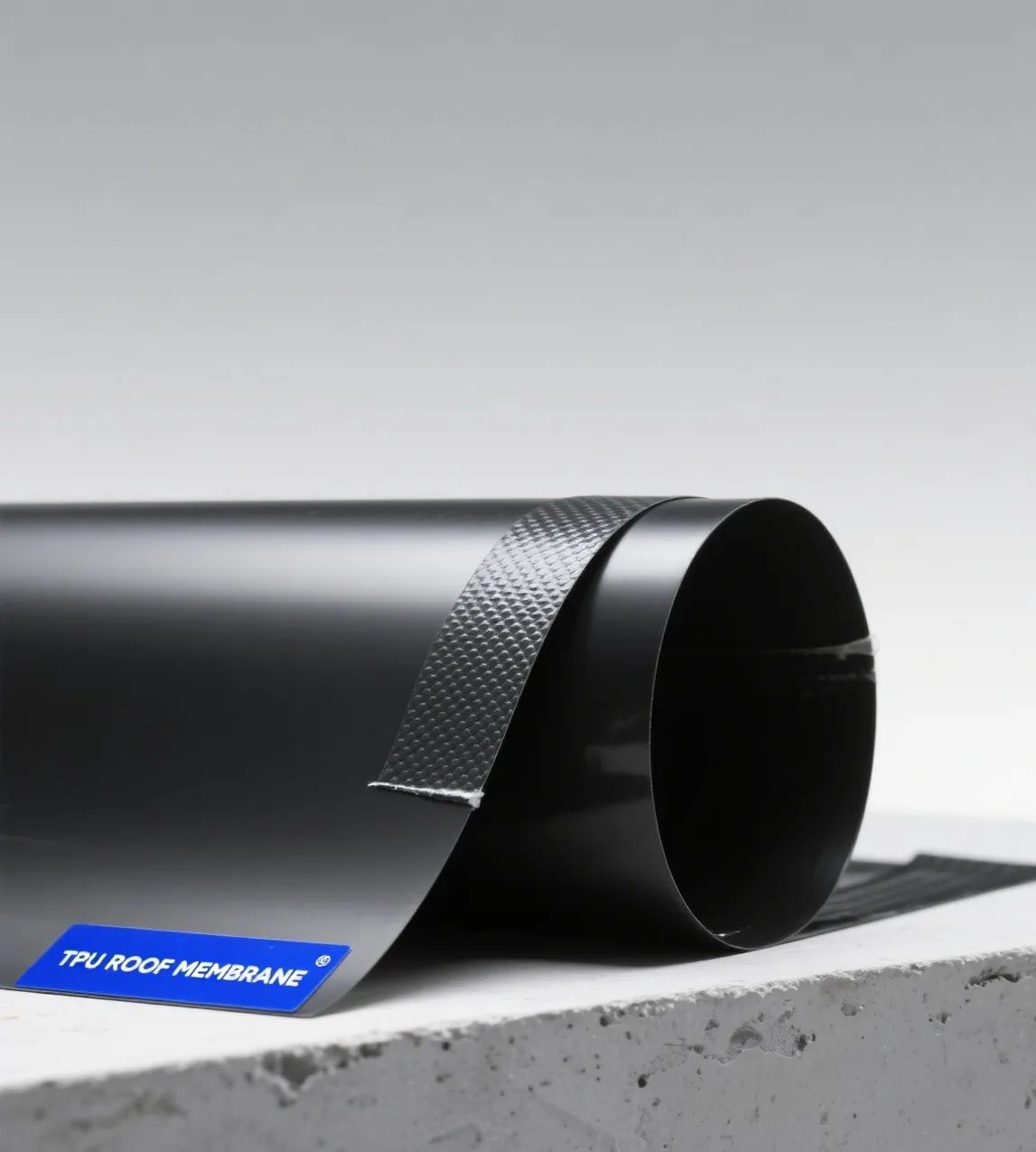
Tpu roof membrane vs tpo membrane is a comparison that usually arrives late, when a specification has already been written around one of them and a contractor has raised a doubt. Both are thermoplastic single-ply membranes, both are white or light grey by default, and both are joined with hot air. The similarities are precisely why the differences are so often missed.
This article compares them on the axes that decide service life: weathering behaviour, welding window, flexibility at low temperature, resistance to oils and chemicals, and how each one behaves when the roof deck moves.
Where the Two Materials Diverge
TPO is a polyolefin alloy. Its polymer backbone is saturated, which is why it resists ultraviolet degradation well and why it has become the default for large flat roofs. TPU is a polyurethane elastomer. Its backbone contains urethane linkages, which give it a different balance of elasticity, abrasion resistance and adhesion to other substrates, and which also make it sensitive to different exposures than TPO is.
That single structural difference explains most of the practical divergence. Where a roof is large, flat, mechanically fastened and lightly trafficked, TPO has an economic advantage. Where the membrane has to follow complex geometry, laminate to a fabric carrier, resist oils, or survive repeated flexing at low temperature, TPU tends to be the more capable material.
How Tpu Roof Membrane Vs Tpo Membrane Compare in Practice
- Weathering. TPO is formulated to resist UV without a plasticiser that can migrate. TPU relies on its formulation and, in exposed service, often on a protective top layer or a coating system.
- Welding window. TPO tolerates a fairly wide band of temperature and speed, which suits site conditions. TPU welds well but the processing window is narrower, so operator control matters more.
- Low-temperature flexibility. TPU retains flexibility well below freezing, which matters on cold-climate projects and during winter installation.
- Chemical exposure. TPU handles oils, greases and many industrial residues better, which is relevant where extract fans or plant discharge reach the roof surface.
| Property | TPO Membrane | TPU Membrane |
|---|---|---|
| UV resistance as supplied | Strong; saturated backbone resists degradation | Good with the right formulation or top layer |
| Hot air weld tolerance | Forgiving band; less sensitive to site variation | Narrower band; rewards a controlled procedure |
| Flexibility in cold weather | Stiffens noticeably at low temperature | Remains flexible well below zero |
| Oil and grease resistance | Limited; can swell on prolonged contact | Good resistance to oils and greases |
| Detail and complex geometry | Needs pre-formed accessories and corners | Conforms and can be laminated to fabric for reinforcement |
No column wins every row, and that is the honest conclusion. A specification that claims otherwise is selling a material rather than solving a roof.
Why the Welding Detail Decides the Roof
Single-ply roofs rarely fail in the field of the membrane. They fail at seams, at penetrations and at terminations, because those are the places where a person had to make a joint under site conditions. A material with a wide welding window is forgiving of a tired crew on a cold afternoon, and that forgiveness is worth real money over a twenty-year life.
TPU compensates differently. Its welding window is narrower, but its ability to be laminated to a reinforcing fabric means a fabricator can produce large pre-formed panels and complex details in controlled factory conditions, leaving less critical work to the site. For intricate roofs, that trade often comes out ahead, because the difficult geometry is made indoors by a machine rather than outdoors by hand.
Questions that usually settle the choice:
• Is the roof large and simple, or small and intricate?
• Will the membrane ever see oil, grease or chemical fallout?
• What is the minimum installation temperature on site?
• Can the details be pre-fabricated off site?
How to Compare Offers Fairly
Two quotes for the same roof rarely describe the same system, and most of the difference hides in accessories rather than in the membrane itself. The sequence below keeps a comparison honest.
- Compare thickness and reinforcement, not just material. A reinforced membrane and an unreinforced one of the same thickness behave very differently in service.
- Ask for seam test records. Peel and shear results from the actual project, not from a generic type test, are the only seam evidence that means anything.
- Check the accessory family. Corners, outlets, walkway pads and bonding adhesives should come from the same system, because mixing brands is the most common cause of premature failure.
- Confirm the warranty structure. A membrane warranty and a system warranty are not the same document, and the difference matters when a claim is made.
Contractors who run those four checks usually find that the cheapest quote was not the cheapest roof, and that the material argument was never the real issue. It was the accessories and the seam procedure all along.
What the Comparison Looks Like Over Twenty Years
Material comparisons are usually made on day one, when both products are clean and both look correct. The useful comparison happens in year eight and year fifteen, when the roof has been through a hundred thermal cycles, two hailstorms and a maintenance campaign that involved somebody dragging a compressor across the surface. That is when the differences in formulation and seam quality become visible, and when the cost of the original decision is finally settled.
Two failure patterns dominate. The first is seam separation, which traces back to welding procedure rather than to polymer chemistry, and which can affect either material if the installation discipline was weak. The second is surface degradation, where a membrane loses its protective finish and begins to chalk, crack or absorb contaminants. In both cases the material sets the ceiling but the workmanship sets what is actually achieved, and a strong specification installed badly will underperform a moderate specification installed well.
That is why the durable question is not which polymer is better, but which system the project team can install and maintain consistently. A roofer who has welded one membrane for a decade will produce a better roof with that material than with a technically superior one they have never handled, and any specification that ignores this will be disappointed by reality.
Where the Base Film Comes From
Roof membranes are laminates more often than single films, and the film that sits behind the fabric carrier decides how the panel behaves when it is folded, welded and walked on. Zhejiang Huanlong has produced functional films since 2007 across three production bases in Zhejiang, with blown film, extrusion and foaming lines, two research centres and more than thirty engineers, so a membrane programme can be developed from the base film upward rather than assembled from available rolls.
Our roofing material is described on the tpu roof membrane page, and an example of base film laminated to fabric for building structures is documented in the roofing and building structures project note. A Huanlong engineer can also review the weld procedure a fabricator intends to use, which is usually where a membrane programme gains or loses its margin.
Frequently Asked Questions About Tpu Roof Membrane Vs Tpo Membrane
Q1. Is TPU more expensive than TPO for a flat roof?
Material cost is generally higher for TPU, but the installed cost gap is smaller than the roll price suggests, because factory pre-fabrication can reduce site labour on complex roofs. On a large simple deck the gap usually stays in TPO's favour; on an intricate one it often closes.
Q2. Can the two membranes be welded to each other?
They are different polymer families, so a direct weld between them is not a reliable joint. Where a repair or an extension brings the two together, use a compatible transition detail or a mechanical termination rather than assuming heat will fuse them.
Q3. Which material handles foot traffic better?
TPU generally resists abrasion and puncturing better, which makes it a reasonable choice on roofs with regular maintenance access. On either material, walkway pads at service routes extend life more than any material substitution does.
Q4. Does colour affect the choice?
Light colours reduce heat gain on both materials, which matters for cooling load. TPU accepts a wider range of finishes including matte and coloured surfaces, which is relevant where a roof is visible or where a specified colour has to be maintained across a large area.
Q5. What should a specifier ask a film manufacturer?
Ask for the base film construction, the reinforcement it was designed to laminate to, and the certifications the maker holds. Zhejiang Huanlong is certified to OEKO-TEX® 100, Bluesign®, GRS and ISO 9001:2015, alongside ISO 14001 and ISO 45001. Where a project requires additional fire or weathering test standards, request the specific test reports for the assembly rather than for the film alone.
The choice between a polyolefin and a polyurethane roof membrane is genuinely application-led, and the specifier who wins is the one who describes the roof before describing the material. Define the geometry, the exposure, the minimum installation temperature and the traffic, and the comparison answers itself, which is the outcome every honest tpu roof membrane vs tpo membrane discussion should reach.