
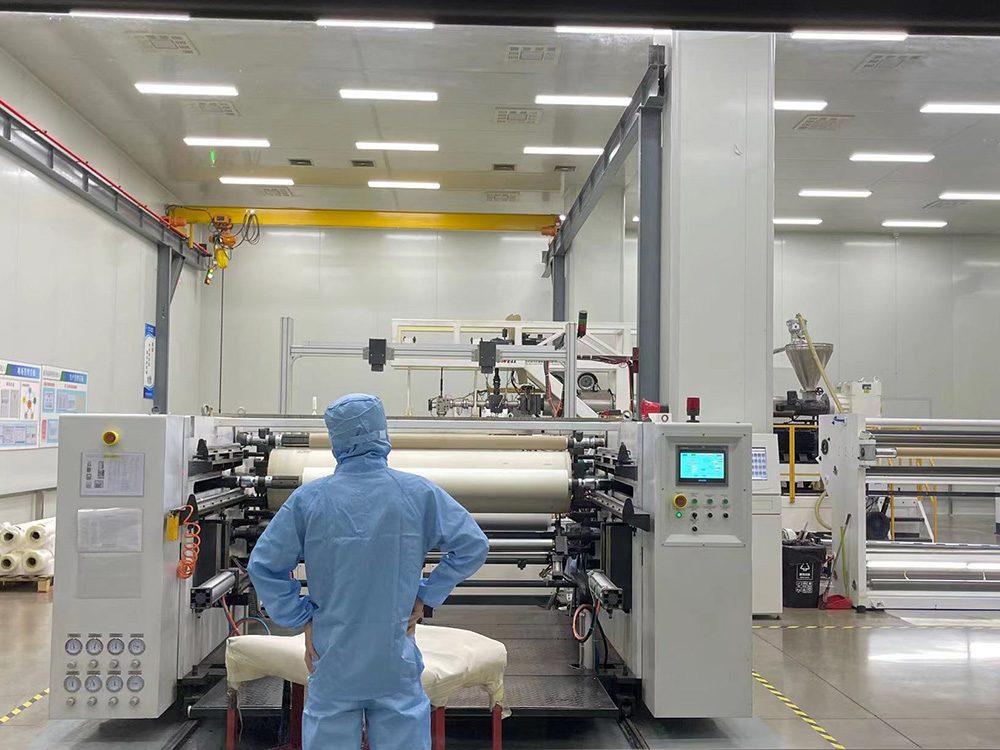
Tpu protective film for lithium battery cells is a temporary surface layer used during cell and pack assembly to keep a delicate surface intact while it travels between processes. It matters because a cell that has passed every electrical test can still be rejected for a mark on its casing, and that rejection happens at the most expensive point in the whole production sequence.
Battery manufacturing is unusual in how much value is stacked on top of each incoming part. By the time a cell reaches the end of the line it carries the cost of the active materials, the separator, the housing, the formation cycle and the energy consumed throughout. Protecting the outside of that assembly is therefore not a packaging concern, it is a yield concern, and yield is the language a battery plant understands.
What Tpu Protective Film for Lithium Battery Cells Has to Deliver
Three properties dominate the requirement. The film has to be electrically suitable for a surface that sits close to live components. It has to tolerate whatever thermal step the process applies, whether that is a drying stage or a warm stacking environment. And it has to remove cleanly, because a cell cannot be washed by hand and any residue stays with the finished product.
There is a fourth consideration that is easy to overlook: cleanliness. A cell line is often managed to a cleanliness discipline that has nothing to do with cosmetics, and particulate introduced by a protective layer is a genuine concern. A film that sheds dust when it is peeled is worse than no film at all, because the contamination arrives at exactly the moment operators believe the surface is being protected.
Material compatibility completes the list. Adhesive chemistry that works perfectly on coated steel may behave differently on an aluminium housing or a polymer sleeve, and the wrong pairing shows up either as poor adhesion during handling or as a transfer mark discovered at final inspection. Both outcomes are avoidable at the specification stage and expensive to correct afterwards.
Where Cell and Pack Lines Quietly Lose Yield
- Transfer between stations. Automated handling is consistent in force but not in contact point, and repeated contact leaves a pattern that inspection treats as a defect.
- Tray and magazine wear. Reusable carriers accumulate burrs over their life, and those edges mark products at scale before anyone thinks to inspect the carrier.
- Formation and ageing racks. Long dwell in warm conditions is the stage where adhesive behaviour either holds or fails.
- Pack assembly and disassembly. Modules are handled after they already contain finished cells, so damage here writes off far more than a single unit.
| Line Stage | Why Damage Is Costly Here | Film Property That Matters |
|---|---|---|
| Cell assembly | Active materials already consumed | Thin, conformable, low particulate |
| Formation and ageing | Days of line time invested in each unit | Heat tolerance; no adhesive creep |
| Tray and magazine handling | Scrap scales with every cycle | Abrasion resistance |
| Module and pack assembly | A rejected pack loses many cells at once | Clean release; no residue on metal or polymer |
| Final inspection | Rejects surface after full cost is absorbed | No optical or visible trace after removal |
Read the table from the bottom up and the economics become obvious. The later a defect is detected, the more accumulated cost it destroys, and the cheapest place to prevent it is at the first handling step rather than at inspection.
What a matched protective film contributes on a cell line:
• Fewer cosmetic rejects at the point of highest accumulated cost.
• Handling confidence for operators working to a cycle time.
• A cleaner surface at the moment of assembly, not after cleaning.
• A removal step that fits the line instead of interrupting it.
Electrical, Thermal and Chemical Expectations
Because a protective layer sits close to conductive parts, the specification conversation should include the electrical requirements the plant works to rather than being treated as a purely mechanical question. Any material used inside a battery assembly should be evaluated against the standards your design authority applies, and where construction-level material standards such as flame spread classifications are relevant, those should be confirmed against the actual documentation rather than assumed.
Thermally, the question is not only peak temperature but duration. A short excursion during a drying stage places different demands on an adhesive than a prolonged warm soak in an ageing area. Suppliers who ask which stage the film occupies are asking the right question, because the same product can perform well in one position and poorly in another.
Chemically, the risk is interaction rather than breakdown. Residues that stay invisible on a dark housing become obvious on a bright one, and any transfer onto a sealing surface can affect how a component behaves later. That is why removal testing belongs in the approval process alongside adhesion testing, and why a sample round on the real substrate is worth more than a data sheet.
Specifying Film for a Cell Line
The most reliable way to specify is to describe the journey of the part rather than the part itself. Films are chosen against dwell time, substrate, temperature exposure and removal method, and those four variables can all be stated by a process engineer without disclosing anything commercially sensitive.
- State the dwell time end to end. From application to removal, including any queue time in an ageing area that nobody counts as process time.
- Name every substrate the film touches. A film approved on a housing may behave differently on a terminal area or a polymer sleeve.
- Fix the removal step in the process document. If nobody owns removal, it happens late, in a hurry, and badly.
- Trial a full carrier cycle. A film that works on one cell may fail when a magazine of cells is cycled repeatedly through the same station.
It also helps to decide early who removes the film and with what tool. A removal method that suits a laboratory does not necessarily suit an operator wearing gloves and working against a takt time, and the difference shows up as edge tearing and residue rather than as an obvious failure.
Sourcing Protective Film for Battery Manufacturing
Battery programmes change quickly, and a supplier who cannot reformulate becomes a bottleneck. That is the practical argument for dealing with a manufacturer rather than an intermediary. Zhejiang Huanlong has made functional films since 2007 and holds OEKO-TEX® 100, Bluesign®, GRS, ISO 9001:2015, ISO 14001 and ISO 45001, with blown film, extrusion and foaming lines running across three production bases in Zhejiang alongside two R&D centres and more than thirty engineers.
The relevant material family is documented on the Tpu protective film page, and the surrounding portfolio for electronics and industrial use can be reviewed in the product catalogue. Huanlong works on a specification-first basis, which for battery buyers means starting with the process route and the substrate list rather than with a stock thickness.
Frequently Asked Questions About Tpu Protective Film for Lithium Battery Cells
Q1. Can tpu protective film for lithium battery cells be used inside a pack?
That depends entirely on the electrical and thermal requirements your design authority sets, and those should be confirmed against documentation rather than assumed from a general product description. Our role as a film manufacturer is to make the material properties available so your engineers can approve it properly.
Q2. Will the adhesive leave residue on the cell housing?
Residue risk is a function of adhesive type, dwell time and temperature, not of the film family as a whole. The reliable way to settle it is a trial on your actual housing material over the same duration and temperature profile the line will apply, followed by inspection in raking light.
Q3. Does a protective layer add particulate to a clean process?
It can, if the film tears when peeled or if the liner sheds during application. Ask for the removal behaviour to be demonstrated, watch the peel in the actual environment, and check whether fragments are produced at high unwind speeds rather than only at hand speed.
Q4. Should the film be applied by hand or in line?
In-line application gives the most consistent result, but it places demands on unwind tension and liner release that not every film meets. If the volume justifies automation, involve the film supplier in the applicator specification early, because retrofitting a suitable web to an existing machine is harder than choosing both together.
Q5. What should a battery plant send to a film manufacturer?
The process route with dwell times, substrates involved, temperature exposure and the planned removal step are enough for a first recommendation. Zhejiang Huanlong manufactures in-house, so a formulation can be adjusted to a specific line condition and repeated for subsequent volumes.
Yield in a battery plant is decided long before the electrical test, in the handling steps that nobody photographs. Treat the protective layer as part of the process rather than part of the packaging, trial it on the real substrate at the real dwell time, and own the removal step in the process document. Specified that way, tpu protective film for lithium battery cells stops being a consumable line item and becomes a measurable yield lever.