
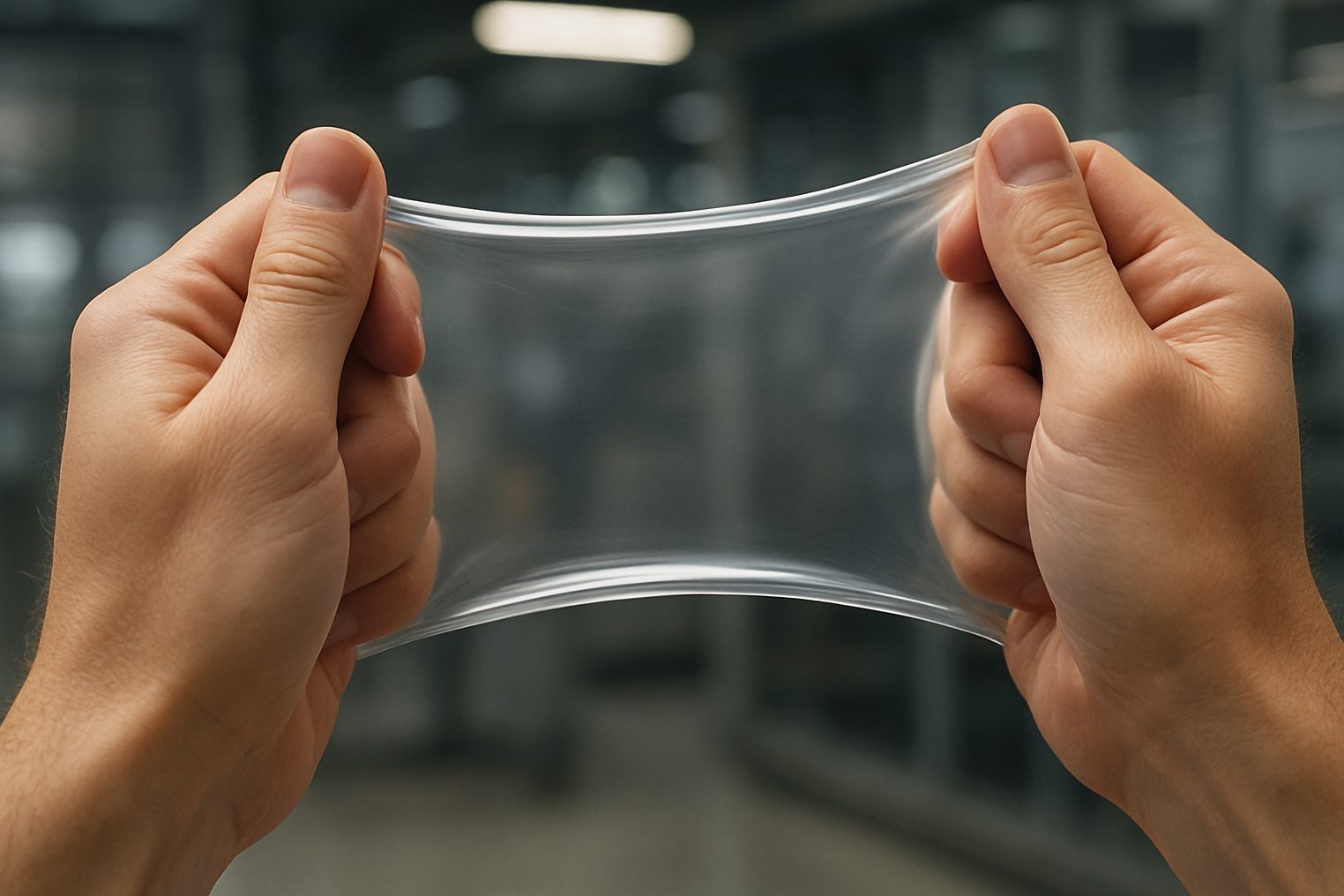
Tpu protective film for solar panels is a temporary surface film applied to module glass, backing sheets or frames so that the product reaches the array without cosmetic damage. It matters because a module spends far longer in transit and on a roof than it does on the production line, and every scratch that lands in that window becomes a warranty conversation about performance rather than appearance.
Module makers spend heavily on lamination quality and then lose margin to handling. The pattern is familiar to anyone who has audited a shipment: units leave the factory clean, arrive at a port after several transfers, sit in a container through a humid week, and get lifted onto a roof by a crew working to a schedule. Nobody sets out to damage the product, but the cumulative handling is what the film has to absorb.
What Tpu Protective Film for Solar Panels Has to Withstand
Four conditions define the requirement. The film has to hold through mechanical handling, including the corner contact that happens whenever a module is stacked. It has to tolerate outdoor heat during intermediate storage on a site compound. It has to release cleanly after weeks or months in place, because a module is not going to be cleaned of adhesive residue on a rooftop. And it has to leave no trace on an anti-reflective coating, which is the surface most sensitive to chemical interaction.
The anti-reflective layer is where good intentions usually go wrong. Coatings of that type are engineered to manage light, and some adhesive systems change how the surface behaves optically. The result is not damage in the conventional sense, it is a module that looks different from its neighbours once the film comes off, and that is a defect a site inspector will notice immediately.
The Three Failure Points Between Factory and Rooftop
- Pallet stacking pressure. Modules are stacked in quantities that place continuous load on the outermost unit, and an adhesive that creeps under that load leaves a shadow line.
- Container heat and humidity. A closed container in summer reaches conditions no laboratory cycle fully reproduces, and the film is the first layer to show it.
- Roof handling by a working crew. Gloves, harnesses, edge clamps and walking across a laid array all make contact with the surface.
| Stage | Dominant Risk | What the Film Must Do |
|---|---|---|
| Packing and stacking | Compression and corner contact | Hold without creep; add a cushion at contact points |
| Ocean and land freight | Heat, humidity, vibration | Stay bonded; not transfer or print onto the finish |
| Site compound storage | Direct sun, dust, rain cycling | Survive UV exposure for the agreed dwell period |
| Installation on the roof | Abrasion from tools and clamps | Resist scuffing; peel away in one piece |
| Commissioning and inspection | Residual adhesive visible in daylight | Leave no visible trace or optical change |
Mapping a shipment against these five stages usually reveals that the film is being asked to do its hardest work in the stage nobody planned for. Compound storage, in particular, is routinely underestimated because the delay is caused by the construction schedule rather than by logistics.
What correctly specified module protection prevents:
• Cosmetic rejects that fail inspection before the array is even energised.
• Adhesive shadow lines that cannot be removed on a roof.
• Disputes about who damaged a module between factory gate and site.
• Installer time lost to inspecting and quarantining suspect units.
Why Module Makers Prefer Film to Paper Interleaving
Interleaving paper is cheap and it stays where it is placed, which is why it remains common. Its weakness is that it only protects where it exists. It does nothing for the frame, the junction box area or the edges, and once a module is lifted out of the stack onto a roof, the paper is gone and the surface is bare. Film covers the surface rather than the gap.
The second argument is process fit. Modern module lines run at speeds that do not tolerate a manual step, so any protection has to be applicable in-line. A film that unwinds consistently and releases without leaving residue can be integrated, whereas a paper layer tends to be added by hand at the end of the line, which reintroduces the handling risk the protection was meant to remove.
Specifying Film for a Module Line
Specification should start from the shipment rather than the material. Describe the route the module takes, how long it waits, and what it is stacked against, and the film requirement becomes a set of measurable conditions rather than a preference. Where a maker cannot answer those questions in writing, the specification has not been done.
- Define the dwell period honestly. The storage+transit+install window, not the optimistic version, is what drives the adhesive selection.
- Name the surface. Anti-reflective coated glass, backsheet and aluminium frame all behave differently; one film rarely suits all three.
- Test on the real stack height. Compression behaviour appears only at production stacking, never in a flat sample.
- Set a removal method. Decide who removes the film, with what, and at which point in the schedule, then write it into the installation pack.
Working With a Film Manufacturer on Photovoltaic Applications
Because the requirement is a formulation question, it is worth dealing with the producer rather than a trader. A maker can adjust an adhesive system for a specific dwell period or surface, while a reseller can only pass the request upstream and hope. Zhejiang Huanlong has manufactured functional films since 2007 and holds OEKO-TEX® 100, Bluesign®, GRS, ISO 9001:2015, ISO 14001 and ISO 45001, and runs blown film, extrusion and foaming lines across three production bases in Zhejiang with two R&D centres and more than thirty engineers.
For photovoltaic buyers, the surface-protection range is described on the Tpu protective film page, and adjacent materials for electronics and outdoor use can be reviewed in the product catalogue. Huanlong works with module makers on a specification-first basis, which in practice means starting from a shipment audit instead of a price list.
Frame Protection Is Half the Job
Most conversations about module protection focus on the glass and forget the frame. In practice the frame is where a shipment is handled, strapped and levered, and it is the part that touches the tray or pallet at every transfer. Anodised aluminium frames mark easily, and a scuff on the visible edge of a module on a pitched roof is impossible to hide from the customer who paid for the array.
Frames also behave differently from glass in one important respect: they are curved, they have mitred corners and they collect adhesive at exactly those two features. A film that conforms well on flat glass can lift at a mitre joint within days, and once an edge lifts the film becomes a trap for grit. That is the reason a single specification covering glass, backsheet and frame is often a compromise, and why splitting the requirement is worth considering at the packing design stage.
Frequently Asked Questions About Tpu Protective Film for Solar Panels
Q1. How long can tpu protective film for solar panels stay in place?
It depends on the adhesive system and the exposure the module meets, so the figure should come from the maker for your route rather than from a general rule. The important discipline is to declare the real dwell period at the enquiry stage, because an underestimated window is the main cause of residue complaints.
Q2. Will the film change the appearance of anti-reflective glass?
It should not, and that is precisely the property worth testing. Ask for a sample on the same coating your line uses, apply it, expose it for the expected duration and then remove it. A supplier who cannot support that trial is asking you to carry the risk.
Q3. Is film worth it if we already strap modules together?
Strapping controls the bundle, it does not protect the surface inside it. Edge contact and stacking pressure remain, and both produce marks that a site inspector can see. Film addresses the interface between units, which is a different problem from bundle integrity.
Q4. Who should remove the film, the factory or the installer?
Removing it at the last possible moment gives the most protection, which usually means the installer. That decision has to be written into the installation pack at the start, because a crew that has not been told will either leave the film on and fail inspection or remove it too early and lose the benefit.
Q5. What should a module maker send to a film manufacturer?
The shipment route with timings, stack heights, the glass and frame surfaces involved, and the point at which removal is planned. Zhejiang Huanlong manufactures rather than resells, so a film can be matched to the route and repeated for later production volumes.
Module protection looks like packaging until the first container is rejected, and by then the discussion has moved from procurement to claims. Audit the route, declare the real dwell period, and test on the actual surface before committing a line. Specified that way, tpu protective film for solar panels turns an unpredictable handling loss into a controlled, repeatable process cost.