
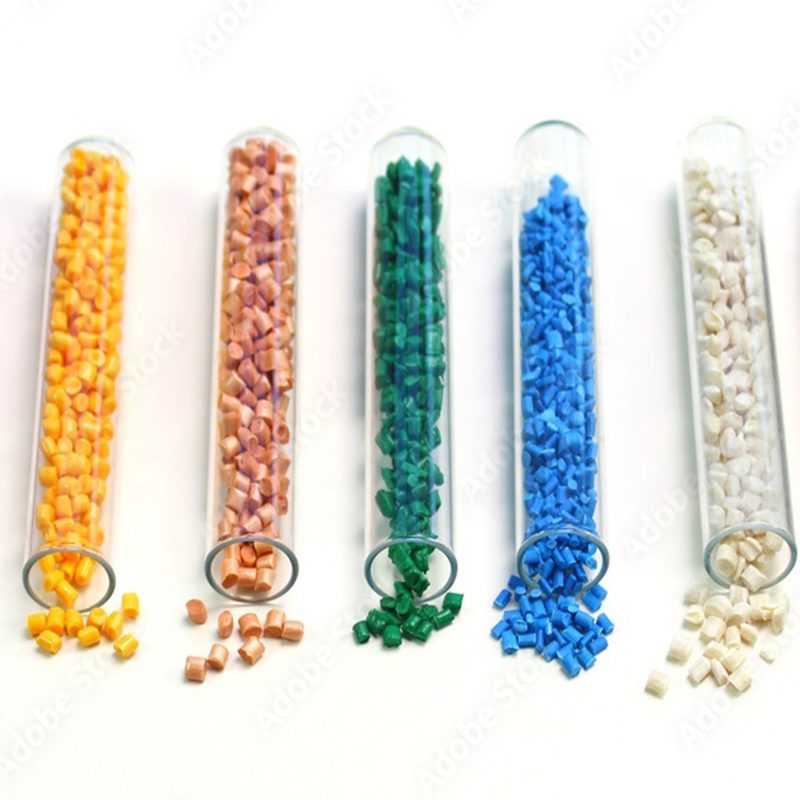
Thermoplastic polyurethane tpu film hardness is quoted on the Shore A or Shore D scale, and buyers often treat it as a single quality number: softer for comfort, harder for durability. In practice hardness is a system variable. It governs how the film bonds, how it flexes through thousands of cycles, how it feels in the hand and how a finished laminate ages. Choosing it well is mostly a matter of knowing which of those four the product is actually judged on.
This article sets out what changes as hardness moves, where the common specification mistakes sit, and how to test a candidate grade so that the answer means something on a production line rather than on a datasheet.
What Moves When Hardness Moves
Hardness in a thermoplastic elastomer is a proxy for the ratio of hard segments to soft segments in the polymer chain. Raise the hard-segment share and the material becomes stiffer, stronger in tension and more resistant to creep, but it also loses elasticity and can become noisy and less compliant on a curved surface. Lower it and the film drapes beautifully, conforms to complex geometry, and recovers from deformation, but it may take a permanent set under continuous load.
The practical consequence is that hardness and thickness are not interchangeable. A stiffer film can sometimes be made thinner without losing tensile strength, while a softer film may need more thickness to deliver the same puncture resistance. Treating the two as independent line items in a specification is one of the most common reasons a first trial underperforms.
How Thermoplastic Polyurethane Tpu Film Hardness Shows Up in Service
- Bond strength and anchorage. A harder grade resists the deformation that would peel an adhesive away from a textured substrate, so it often holds better on the materials that are hardest to stick to.
- Flex life. Flex-crack resistance is not simply better or worse with hardness. There is usually a useful window, and grades on either side of it fail earlier for different reasons.
- Conformability. Installers working over tight radii, seams or complex mouldings feel hardness immediately, and a grade that is one step too stiff turns a routine application into a two-person job.
- Hand feel and acoustics. In textile and interior applications, hardness shows up as drape and as noise. A film that rustles does not read as premium, whatever its mechanical numbers say.
| Requirement | What Soft Grades Give You | What Hard Grades Give You |
|---|---|---|
| Conformability on curves | Excellent, fewer wrinkles at tight radii | Requires heat and skill; edge lifting risk rises |
| Tensile strength | Lower; may need a heavier gauge | Higher per unit thickness, useful for downgauging |
| Creep under steady load | Takes permanent set more readily | Holds shape over long static loads |
| Hand feel and drape | Soft, textile-like, quiet | Firm, structural, can rustle |
| Abrasion behaviour | Smears rather than scuffs, but wears faster | Better scuff resistance, sharper damage when it occurs |
Notice that no row has an unconditional winner. That is the point. Hardness is a trade, and the specification should name the trade the product can live with.
Where Specification Mistakes Cluster
The most frequent error is copying a competitor's grade without knowing why they chose it. A rival may have selected a harder film because their conversion process runs hotter, or a softer one because their installer base is less experienced. Without that context the number is meaningless.
The second error is testing hardness in isolation. Flex life depends on hardness, thickness and the radius of the bend together, so a bench result measured flat tells you very little about a part that bends through a two-millimetre radius ten thousand times. Build the test around the real geometry and the comparison becomes actionable.
Before locking a hardness grade, confirm:
• The tightest radius the film must follow without heat.
• The number of flex cycles and the temperature at which they occur.
• Whether the film sits under a constant load, which is where softer grades set.
• The substrate and the adhesive family, because the three are chosen together.
Testing a Candidate Grade Properly
A structured evaluation takes a week and prevents a year of rework. The sequence below keeps the comparison honest by changing one variable at a time.
- Ask for two adjacent grades. A supplier that only offers one hardness in a family is limiting the experiment before it starts.
- Hold thickness constant. Otherwise the comparison measures two variables and explains neither.
- Run the flex and bond tests at service temperature. Hardness behaviour shifts with heat, and the ambient bench is rarely the worst case.
- Include the installer. Twenty minutes of application testing by the person who will do the work tells you more about conformability than any laboratory figure.
Run in that order, the outcome is usually a clear preference rather than a table of near-identical numbers, because the field and the bench tend to agree once they are measuring the same thing.
Hardness Inside a Multi-Layer Construction
Most real products are laminates rather than single films, and the hardness that matters in service is the hardness of the stack. A soft outer layer over a firm core can deliver drape at the surface and dimensional stability underneath, which is exactly the combination a single grade struggles to provide. Where a product is judged on both hand feel and shape retention, splitting the requirement across two layers is often cheaper than compromising one number in one layer.
The interaction to watch is creep. A soft layer bonded to a firm one behaves differently from either material alone, because the soft layer can no longer deform freely and the firm layer can no longer resist bending without help. Assemblies that pass individual film tests can still take a permanent set when the pair is loaded together in a warm environment. Test the laminate, not the components, before signing off a structure.
Adhesive choice belongs in the same conversation. A very soft film needs an adhesive that will not fight it during cure, while a hard film needs one that can tolerate the stress concentrations at its edges. When hardness, thickness and adhesive are selected as a set rather than in sequence, first-run results become predictable, and the number of iterations between sample and production falls sharply. That reduction in iterations is usually worth more than any material saving on the roll itself.
Choosing a Film Maker Who Can Tune Hardness
Hardness is formulated, not traded, so the useful partner is the manufacturer. Zhejiang Huanlong has made functional films since 2007 across three production bases in Zhejiang, with blown film, extrusion and foaming lines, two research centres and more than thirty engineers, which means a Huanlong engineer can match a hardness grade to an application rather than pick one from a shelf.
The wider thermoplastic polyurethane family is described on the thermoplastic polyurethane tpu film page, and an example of hardness and lamination interacting in a real structure is documented in our high vapour transmission film project note.
Frequently Asked Questions About Thermoplastic Polyurethane Tpu Film Hardness
Q1. Is a harder TPU film always more durable?
No. Harder grades resist scuffing and creep better, but they can crack earlier in repeated flexing and they offer less impact absorption. Durability has to be defined against a specific failure mode before any grade can be called better.
Q2. How do I convert Shore A to Shore D values?
The scales overlap and there is no exact formula, only approximate correspondence in the overlap zone. If your application sits near the boundary, ask for measurements on both scales from the same supplier rather than converting a competitor's figure yourself.
Q3. Can hardness be adjusted without changing the rest of the specification?
Not entirely. Changing the hard-segment ratio shifts tensile strength, elongation, softening behaviour and adhesion together. Treat a hardness change as a new material qualification rather than as a minor amendment, even when the gauge stays the same.
Q4. Does temperature change the effective hardness in service?
Yes, and this is why bench results can be misleading. A grade that conforms easily in a warm workshop may behave quite differently on a cold site. Specify the application temperature range and test within it.
Q5. What should I request from the supplier with the sample?
Ask for the grade's hardness on the stated scale, the test method used, the tensile and elongation data at the same thickness you will buy, and the certifications the maker holds. Zhejiang Huanlong is certified to OEKO-TEX® 100, Bluesign®, GRS and ISO 9001:2015 along with ISO 14001 and ISO 45001, so the compliance position can be checked directly.
Read together, bonding and flex life describe the same underlying decision: how much stiffness the product can tolerate. Get the answer from the application, test two adjacent grades at constant thickness, and confirm the choice in the hands of the person who installs it. Handled that way, thermoplastic polyurethane tpu film hardness stops being a number copied from a competitor and becomes a deliberate part of the design.