
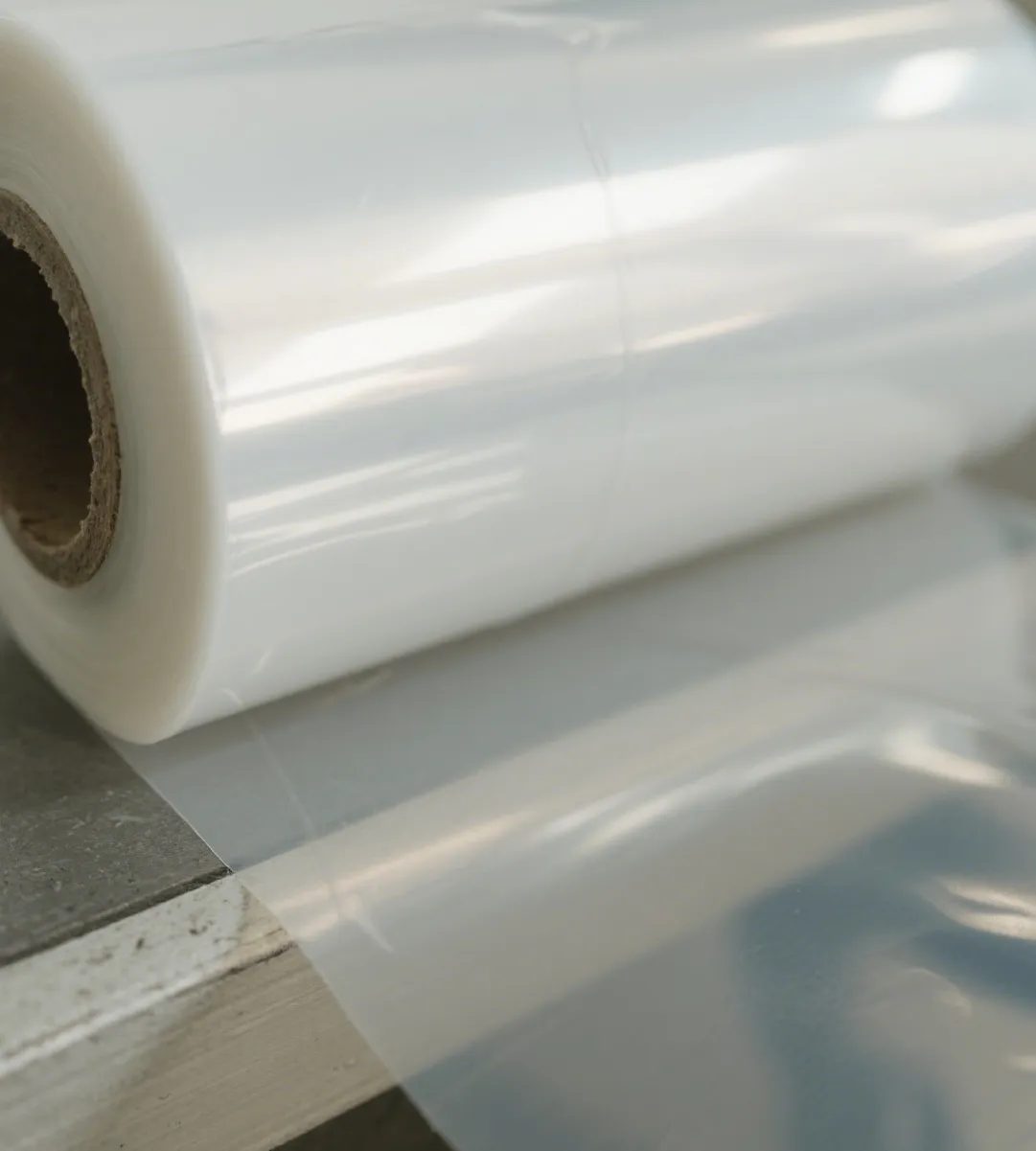
Thermoplastic polyurethane tpu film thickness is the single number most often specified by habit rather than by calculation, and it is the one that quietly drives cost, weight and processing difficulty on every downstream operation. A gauge chosen in a meeting to feel safe typically ends up twenty to forty percent heavier than the application requires, and that excess is paid for in material, in slower line speeds and sometimes in a stiffer finished part.
This is a practical route through the specification, starting from what the part has to survive rather than from a competitor's datasheet, and ending with a gauge tolerance you can actually inspect.
Start From the Load Case, Not From the Gauge
Every film specification is a balance between four requirements that pull in different directions: tensile strength, elongation at break, puncture or tear resistance, and flexibility in service. Thickness is the lever that moves all four at once, which is precisely why it should be the last variable to be fixed rather than the first. Work out which of the four dominates the failure you are trying to prevent, and the gauge window narrows considerably.
A protective film on a flat panel, for example, is rarely governed by tensile strength. It is governed by puncture from handling and by adhesion over a long service period. A membrane exposed to wind uplift is the opposite case, where tensile performance and seam strength set the floor. Applying the same gauge to both is how overbuilding starts.
What Actually Forces Thermoplastic Polyurethane Tpu Film Thickness Upward
- Handling damage during assembly. Most real-world puncture happens in the factory and on site, not in the finished product, so the film is often specified against its harshest twenty minutes rather than its service life.
- Adhesive anchorage. Very thin gauges can telegraph substrate texture and lose the flat finish a customer expects, which pushes the specification up one step.
- Removal without tearing. If the film has to be stripped in one piece after years in place, a heavier gauge gives the installer something to pull against.
- Opacity or colour requirements. Where a specific masking level is needed, thickness and pigment loading interact, and the pair has to be solved together.
| Application Type | Property That Sets the Gauge | Overbuilding Symptom |
|---|---|---|
| Surface protection film | Puncture during handling and clean removal | Stiff film that will not conform to curvature |
| Lamination base film | Bond strength and dimensional stability through heat | Excess weight and a stiffer final laminate than the market expects |
| Inflatable structure | Burst pressure and seam integrity over time | Pack volume too large for the intended transport |
| Textile lamination | Drape, hand feel and wash durability | A garment that feels like a shell |
| Automotive paint protection | Impact absorption without visible orange peel | Optical distortion at panel edges and tight radii |
Each row points to a different specification conversation. The practical value of the table is diagnostic: if two products share a row, they can often share a gauge.
How Tolerance, Not Average, Decides Yield
Two suppliers can quote the same nominal gauge and deliver very different yields, because what matters on a converting line is the spread across the web and along the roll. A tight tolerance allows a lower nominal value to be specified safely, and the saving compounds across a year of production. A loose tolerance forces the buyer to order heavier material as insurance.
Ask for the measurement method as well as the number. Capacitance gauges, gravimetric checks and micrometer readings at fixed points all produce slightly different pictures, and a specification that does not name the method will be argued about at goods-in rather than resolved at the machine. Once the method is agreed, the acceptance window becomes a routine inspection rather than a negotiation.
A gauge specification is complete only when it states:
• The nominal value and the tolerance band around it.
• The measurement method and the sampling frequency.
• The properties that were checked at that gauge, not at a reference gauge.
• How the film behaves if the gauge drifts to either edge of the band.
Reducing Thickness Without Losing Performance
Downgauging is a legitimate engineering project, not a cost-cutting exercise, and it has a defined order of operations that keeps risk contained.
- Establish the true current failure mode. Collect scrap and field returns for a month. If failures are adhesive or handling-related, a thinner gauge may change nothing at all.
- Change one variable at a time. Reduce gauge first, keep hardness and surface treatment fixed, and retest the same properties with the same method.
- Re-check the conversion step. A thinner web behaves differently under tension, so tension setpoints and roller contact pressure usually need revisiting.
- Validate in the field before switching supply. Run a limited batch in real service, because accelerated tests rarely reproduce site handling.
Most programmes that follow that order recover a meaningful share of material cost and finish with a better-understood product. Programmes that skip step one usually discover, several months later, that they have made a thin product with the same old failure mode.
Reading a Supplier Datasheet Without Being Misled
Datasheets exist to compare favourably, and thickness is where that tendency shows up most often. A tensile figure is only meaningful when the test thickness is stated, because strength scales with cross-section rather than with material quality. A puncture value means nothing without the probe geometry and the support ring behind it. A softening point quoted without a method cannot legitimately be placed beside a competitor's number, because the two tests may differ by more than the materials do.
The remedy is a short, standardised request that every supplier answers in the same format. Name the thickness you intend to buy, ask for the mechanical data measured at that thickness rather than at a reference gauge, and ask which test standard was used for each figure. Three lines of email eliminate most of the ambiguity that otherwise resurfaces months later during a quality dispute. Anyone unwilling to answer in that format is telling you something useful about how they will behave after the order is placed.
It also helps to compare like for like across a shortlist. Put three suppliers in a single table with thickness, method, tensile, elongation and tolerance side by side, and the differences that matter become visible immediately. Documents that cannot be reduced to that table usually contain a substitution somewhere, whether in gauge, additive package or surface treatment.
Getting the Gauge Right With Your Film Maker
Thickness is a manufacturing variable, so the conversation is more productive with the extruder than with a trader. Zhejiang Huanlong has produced functional films since 2007 across three production bases in Zhejiang, with blown film, extrusion and foaming lines, two research centres and more than thirty engineers. That structure allows a gauge trial to be run against a named application rather than against a catalogue page.
The thermoplastic polyurethane material family itself is documented on the thermoplastic polyurethane tpu film page, and comparable grades used across other industries are listed under all products. Bring your failure data, the conversion line and the target service life to a Huanlong engineer, and the gauge becomes a calculated answer instead of a guess.
Frequently Asked Questions About Thermoplastic Polyurethane Tpu Film Thickness
Q1. Is there a minimum thickness for a functional TPU film?
There is a practical floor set by handling rather than by polymer science. Below a certain gauge, films become difficult to apply without wrinkling and difficult to strip in one piece, so most industrial applications settle above that floor even where the load case would allow less.
Q2. Does thickness affect the adhesive performance of a film?
Indirectly, yes. A thicker film resists the deformation that would otherwise be transferred into the adhesive layer, so it holds better on textured substrates. On very smooth surfaces the difference is small, which is why the substrate has to be part of the specification.
Q3. Can I use one gauge across several products to simplify purchasing?
Often you can, and the saving in inventory and qualification is real. Map the applications by dominant failure mode first. If two products are governed by the same property, sharing a gauge is sensible; if they are not, consolidation simply moves the overbuilding somewhere else.
Q4. How should gauge be verified at goods-in?
Take readings at defined positions across the web and along the roll rather than at one point, and record them against the agreed method. A single reading at the roll edge is the least representative measurement available and is a common source of avoidable disputes.
Q5. What certification should I ask for alongside the gauge?
Ask for what the maker holds rather than what the market assumes. Zhejiang Huanlong is certified to OEKO-TEX® 100, Bluesign®, GRS and ISO 9001:2015, together with ISO 14001 and ISO 45001. Where a customer programme requires additional test standards, treat them as test reports to be requested, not as standing claims.
Getting thermoplastic polyurethane tpu film thickness right is less about finding a clever material and more about refusing to decide in the wrong order. Fix the failure mode, fix the tolerance, fix the measurement method, and the number falls out of the analysis. Specify it the other way round and you will spend the next three years paying for a decision that took two minutes, which is why thermoplastic polyurethane tpu film thickness deserves an afternoon of analysis rather than a column in a template.