
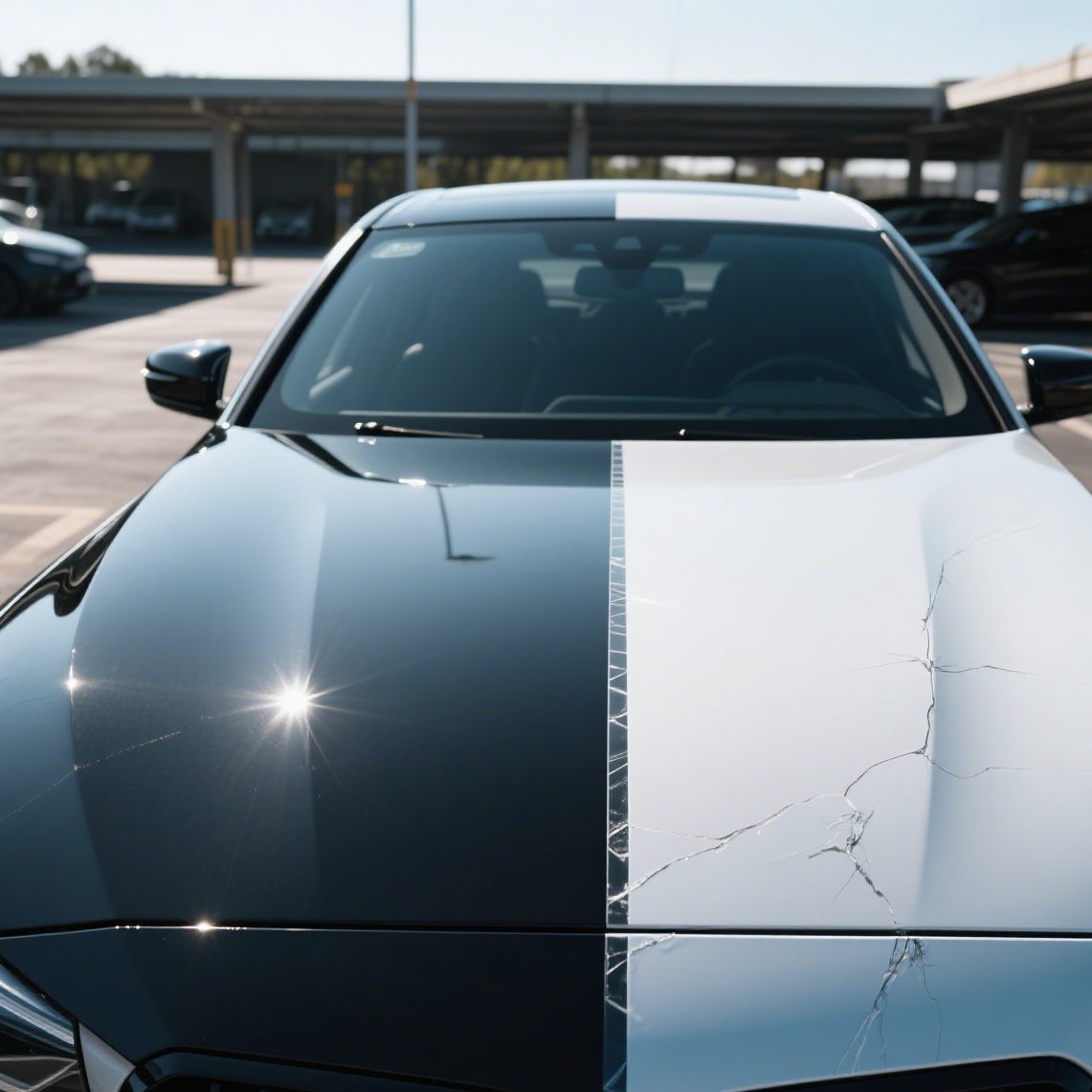
Color change car wrap tpu film moves the material out of the protection category and into the appearance category, and that shift changes every requirement. A clear protective film is judged on whether it holds up and stays invisible; a coloured wrap is judged on how it looks from three metres away, on the day it is installed and on every day afterwards.
This article looks at what a colour wrap demands from the converter who makes it and the installer who applies it, and where the process rather than the material usually decides whether the result looks like paint or like plastic.
Why Colour Raises the Stakes
A transparent film hides small defects because the paint underneath remains the visual subject. A coloured film replaces the paint as the visible surface, so every imperfection becomes the product. Pigment dispersion streaks, thickness variation, surface texture and colour batch differences all move from being internal measurements to being things a customer can see in daylight.
That is why colour wraps are usually supplied as a finished product rather than as a film to be coated locally. Consistent pigment dispersion, controlled gloss level and stable colour from batch to batch require manufacturing control that a converter applying a coating after the fact cannot easily reproduce.
What Color Change Car Wrap Tpu Film Demands From the Converter
- Colour consistency across batches. A wrap is often installed in panel groups, so two rolls from different batches must read as the same colour in daylight and under artificial light.
- Uniform surface character. Gloss, satin and matte finishes have to be flat and consistent, because any variation reads as a patch on a large panel.
- Controlled thickness. Thickness variation changes both colour depth and conformability, so a wide tolerance produces a wrap that installs unevenly.
- Repositionable adhesive. Colour installation involves far more handling and repositioning than clear film, so the adhesive has to allow a second attempt without leaving marks.
| Stage | What Goes Wrong | Who Owns the Fix |
|---|---|---|
| Pigment dispersion | Streaks visible in low-angle light | Film manufacturer; not correctable downstream |
| Surface finish control | Patchy gloss across an installed panel | Film manufacturer |
| Panel removal and refitting | Broken clips, damaged trim, sensor faults | Installer; mitigated by good panel knowledge |
| Stretch around complex geometry | Colour lightening where the film is over-stretched | Installer; technique and heat control |
| Edge finishing | Visible silver line or lifted edge within a season | Installer; wrapping versus trimming decision |
The table is useful for setting expectations before a job is quoted. Two of the five failure modes cannot be fixed on site at all, which means the material choice has already decided the outcome before the first panel is removed.
The Stretch Problem in Coloured Film
Stretching a coloured film changes its appearance, because the pigment concentration per unit area falls as the film thins. On complex bumpers and mirror housings where the film is stretched substantially, an over-worked area can read lighter than the surrounding panel. In a clear film this is invisible; in a coloured one it is a defect the customer will photograph.
Experienced installers manage it in two ways: by choosing where the stretch is applied, planning seams so that heavily formed areas are covered by separate pieces rather than stretched from a large panel; and by keeping heat low and movement gradual, since a hot, fast pull thins the film more than a controlled one. Both techniques cost time, and both should be built into a quotation rather than absorbed as a surprise.
Before quoting a colour change wrap:
• Confirm the film batch covers the whole vehicle, or accept a risk of shade difference.
• Identify the panels that will need seams because of geometry.
• Check whether trim removal is required, and whether the customer accepts it.
• Agree how edges will be finished on every panel.
Installation Sequence That Produces a Paint-Like Result
The difference between a wrap that looks painted and one that looks applied is almost entirely in process discipline. The steps below are the ones that carry the most visual risk.
- Decontaminate and inspect the paint first. Colour film does not hide defects; it preserves them under a uniform surface where they are easier to see.
- Plan the panel order deliberately. Work in an order that lets each panel set before the next is handled, so adjacent edges are not disturbed.
- Keep stretch within a defined limit. Decide in advance which areas will be stretched and by how much, and use inlays or seams elsewhere.
- Post-heat every edge. The perimeter is where a wrap fails, and a controlled warm cycle is what keeps it down through a summer.
A workshop that photographs the finished edges and records the post-heat temperature builds a record that answers most early complaints without argument, because the evidence is specific to a panel and a date rather than a general claim about quality.
What a Customer Should Understand Before Committing
A colour change wrap is often bought as an alternative to a respray, and the comparison should be made honestly. A wrap is faster, reversible and cheaper at the point of application, and it protects the original paint underneath. A respray is permanent, and it can be corrected and polished in ways that a coloured film cannot. Where a customer wants a colour for two or three years before moving the vehicle on, the wrap is usually the better instrument; where the change is intended to be permanent, film is the wrong tool.
Customers should also be told plainly which panels will carry a seam. On most vehicles some seams are unavoidable, and a well-planned seam in a recess or along a body line is nearly invisible, while an unplanned one in the middle of a door skin is the first thing anyone notices. Agreeing that layout before installation is the single most effective way of avoiding an argument at handover, and it costs nothing more than a conversation held at the right moment.
Where the Film Comes From
Colour consistency and finish control are manufacturing outcomes, so the specification conversation belongs with the film maker. Zhejiang Huanlong has produced functional films since 2007 across three production bases in Zhejiang, with blown film, extrusion and foaming lines, two research centres and more than thirty engineers, which supports a colour programme developed around a target finish rather than a coating applied to a stock film.
Our vehicle wrapping material is described on the car wrap tpu film page, and the film families used across vehicle and industrial surfaces sit under all products. A Huanlong engineer can also advise on batch planning for a multi-panel installation, which is the simplest way to remove the most common colour complaint before it happens.
Frequently Asked Questions About Color Change Car Wrap Tpu Film
Q1. Can a colour change wrap be applied over an existing wrap?
It can be done, but the result depends on the condition of the layer underneath. Any lifting, texture or contamination will telegraph through, and adhesion to a previously wrapped surface is less predictable than to paint. Where a clean result is required, removing the old film first is the safer route.
Q2. How does stretch affect the colour?
Stretching reduces the amount of pigment per unit area, so heavily formed regions can appear lighter than flat panels. The effect is manageable with technique and with panel planning, but it cannot be eliminated entirely. Agree with the installer which areas will be seamed rather than stretched.
Q3. Do coloured films carry the same protection as clear ones?
A coloured film protects the paint beneath it in the same way a clear film does, because the barrier mechanisms are the same. Where it differs is in appearance, and in the fact that stone damage will show as a colour break rather than as a chip in the paint. Some installers combine a coloured wrap with protection film in the highest-impact areas.
Q4. How should a coloured wrap be washed?
Hand washing with a pH-neutral product and a clean mitt is the safest routine. Brush washes and aggressive alkaline cleaners dull the surface over time, and the change is more noticeable on a coloured or matte finish than on a glossy one. Avoiding automatic brushes is the single most effective care instruction.
Q5. What should a converter ask the film manufacturer?
Ask for colour tolerances between batches, the finish control method, the film thickness and its tolerance, the adhesive type, and the certifications held. Zhejiang Huanlong is certified to OEKO-TEX® 100, Bluesign®, GRS and ISO 9001:2015, along with ISO 14001 and ISO 45001. Where a customer programme requires additional test standards, request the report for the specific colour and batch.
A colour change wrap is judged by the eye rather than by a datasheet, which is why the specification has to be set by the people who will see the result. Control the batch, plan the stretch, finish the edges and post-heat the perimeter, and color change car wrap tpu film will deliver a finish a customer reads as paint rather than as a product.