
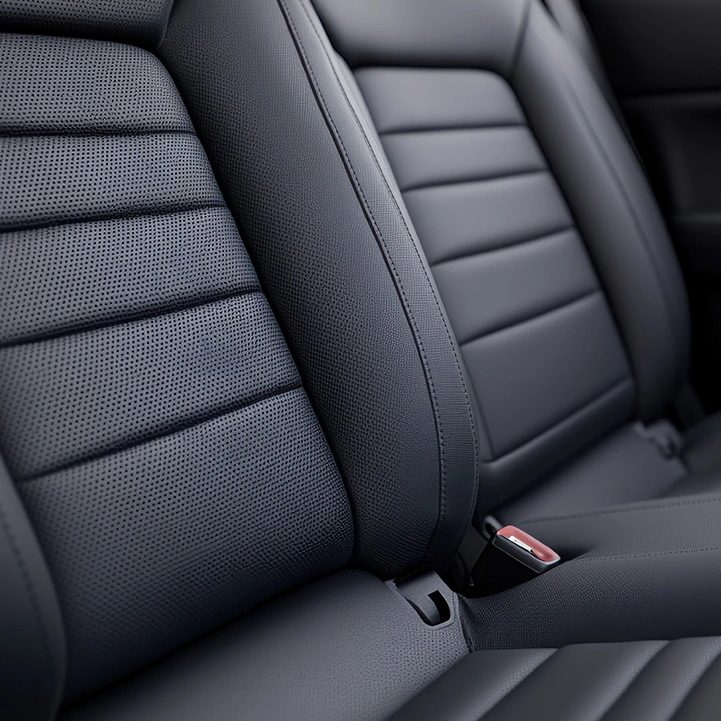
Flame retardant tpu film for automotive interiors appears in a specification for a reason that has nothing to do with comfort: interior materials are regulated for fire behaviour, and a laminate that fails the relevant test cannot be used in a cabin regardless of how well it performs on every other measure.
This article explains where a flame retardant TPU film enters an interior construction, what the test standards actually measure, and why the formulation choice interacts with hand feel, ageing and processing in ways that catch teams out.
Where the Film Sits in an Interior Construction
A modern cabin surface is a laminate, not a single material. A typical seat or door trim assembly combines a decorative outer layer, a foam or spacer layer, a reinforcing scrim and an adhesive system. TPU appears in several of those positions: as a bonding film that joins the layers, as a functional layer that provides water vapour transmission, and increasingly as a foam carrier in lightweight seating structures.
Because it sits inside the stack, a flame retardant film has to do its job without disturbing the layers around it. It must bond reliably to textiles and foams, survive the temperatures used in lamination, and stay flexible enough that the finished seat does not feel stiff. Adding flame retardant chemistry to a polymer changes all of those properties to some degree, which is why the formulation is a compromise rather than a simple additive choice.
What Flame Retardant Tpu Film for Automotive Interiors Must Satisfy
- Interior flammability requirements. Cabin materials are typically assessed against horizontal burn and, where a component-specific standard applies, against vertical burn ratings such as the UL 94 classification.
- Low emission and odour. Anything inside a cabin is exposed to heat and sunlight, so emission behaviour is part of the acceptance criteria as well as fire performance.
- Lamination and ageing performance. The film has to survive the bonding process and years of thermal cycling without delaminating or embrittling.
- Hand feel preservation. A seat surface that rustles or feels boardy will be rejected by the customer long before any technical failure appears.
| Interior Location | Role of the Film Layer | Formulation Pressure |
|---|---|---|
| Seat cover laminate | Bonds the facing textile to the foam layer | Must not stiffen the seat or change its drape |
| Door trim panel | Lamination layer over a moulded substrate | Must bond to a rigid substrate and survive ageing |
| Headliner and pillar trim | Adhesive film for fabric facing | Heat exposure from a sun-soaked roof is severe |
| Acoustic and insulation pads | Bonding layer within a multi-layer mat | Must tolerate uneven surfaces without bridging gaps |
| Foam seat core | Lightweight carrier replacing conventional foam | Fire performance plus compression and recovery behaviour |
The variety is the point. A single flame retardant grade rarely serves all five positions, because the processing route and the surrounding materials differ so much. Teams that try to standardise on one grade usually discover that the compromise works in two locations and disappoints in the other three.
How the Flame Retardant Package Changes Everything Else
Flame retardants work by interrupting the combustion cycle, and they achieve that either in the solid phase or the gas phase. Whichever route is used, the additive is present throughout the polymer and influences properties beyond fire behaviour. Softening behaviour can shift, which changes the lamination window. Surface energy can change, which affects print and adhesive performance. Some systems absorb moisture, which matters in humid service.
The practical advice is to re-qualify rather than to substitute. A flame retardant version of an existing grade is a new material for the purposes of validation, and treating it as a drop-in replacement is the single most common way an interior programme loses a quarter of development time.
When qualifying a flame retardant interior film:
• Confirm which requirement applies to the component, not to the vehicle in general.
• Re-run lamination trials rather than reusing the previous settings.
• Test the finished laminate, because the surrounding layers contribute to the result.
• Check odour and emission alongside fire performance.
Testing the Laminate Rather Than the Film
A film that carries a passing test report in isolation is not evidence that the finished assembly will pass. Foam layers, textile facings and scrims all contribute to how a cabin component burns, and an adhesive that performs well between two films may behave differently when one of those films is replaced by a knitted fabric with a different thermal mass.
The sequence below is the one that produces a defensible result rather than a hopeful one.
- Define the component boundary. Decide exactly which layers are inside the tested assembly, because adding or removing one changes the result.
- Produce samples by the production process. Hand-made laboratory laminates differ from production laminates in bond quality and thickness consistency.
- Test after ageing. Heat ageing can migrate additives and change behaviour, so a fresh sample result is not the whole story.
- Keep the material batch traceable. If a test passes, the report should identify the film batch so that a later production run can be tied back to it.
Following that sequence costs a few weeks at the start of a programme and routinely saves a re-test later, because the common causes of a failed second submission are an undefined component boundary and a laminate that was never made the way production will make it.
There is also a practical point about supply continuity. Interior trim is often made in the same plant for a decade, with small colour and specification changes along the way, and each change can invalidate a fire report if the construction has moved. Keeping the same film grade and the same lamination route across a model life is easier to defend than switching supplier to save a small amount on material, because the re-qualification cost is paid by the tier supplier rather than by the vehicle manufacturer. That is the reason interior programmes tend to value stability over the lowest quoted price.
Working With the Film Manufacturer
Flame retardant formulations are developed against a target standard and a processing route, so the conversation belongs with the maker. Zhejiang Huanlong has produced functional films since 2007 across three production bases in Zhejiang, with blown film, extrusion and foaming lines, two research centres and more than thirty engineers, which allows an interior programme to be developed around the specific component rather than around a catalogue grade.
Our flame retardant range is described on the flame retardant tpu film page, and an example of film used in a cabin seating assembly is documented under automotive comfort seat system. A Huanlong engineer can also advise which layer positions the material is suitable for, which prevents a programme from specifying one grade across a component it cannot serve.
Frequently Asked Questions About Flame Retardant Tpu Film for Automotive Interiors
Q1. Does a flame retardant film always mean a stiffer seat?
Not necessarily, but additives do shift mechanical behaviour, so a stiffness check belongs in the qualification. Where stiffness increases, it can often be offset by a lower film weight or a softer base grade at the same flame performance. It is a solvable problem rather than an unavoidable one.
Q2. Which fire standards are relevant to cabin materials?
It depends on the market and on the component. Horizontal burn tests are standard for interior trim, and component-level classifications such as UL 94 are commonly cited for plastic parts. Always confirm which requirement applies to your specific part with the vehicle manufacturer rather than working from general assumptions.
Q3. Can the film be used next to foam without causing delamination?
It can, provided the softening window of the film is compatible with the foam's tolerance for heat. Foams compress and can collapse if the lamination temperature is raised to compensate for a slow-bonding film, so the pairing should be trialled rather than assumed.
Q4. Are there odour or emission concerns with flame retardants?
Emission behaviour is a legitimate part of interior qualification, and it should be assessed on the finished laminate after ageing rather than on the film alone. Different additive systems behave differently, so ask for emission data for the grade under consideration instead of relying on a category-level assurance.
Q5. What should a tier supplier request from the film maker?
Ask for the flame test report with its method and sample construction, the emission data for the grade, the recommended lamination window and the certifications the maker holds. Zhejiang Huanlong is certified to OEKO-TEX® 100, Bluesign®, GRS and ISO 9001:2015, alongside ISO 14001 and ISO 45001. Where a vehicle programme requires additional standards, request the report for the specific grade and batch.
Fire performance in a cabin is a qualification requirement rather than a selling point, which is why it tends to be addressed late and under pressure. Handling it early, with a component boundary that is defined and a laminate that is made the way production will make it, is what turns flame retardant tpu film for automotive interiors from a last-minute obstacle into a settled line in the bill of materials.