
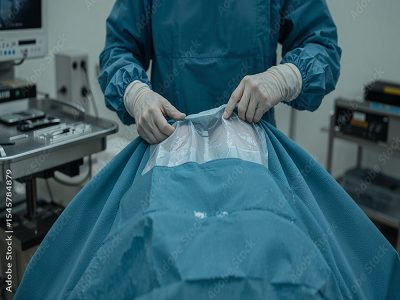
Non porous tpu film for protective clothing looks like a contradiction to anyone who assumes that breathability requires holes. It is not. A monolithic polymer membrane with no pores at all can still transmit water vapour, because vapour dissolves into the polymer, diffuses through it and evaporates on the other side. Liquid water and particles cannot follow that route.
That mechanism is why a non porous film can deliver a genuine barrier against liquids, aerosols and particles while still letting a wearer's sweat escape, and it is the property that makes the material attractive for protective garments rather than merely waterproof ones.
Why Pores Are a Weakness in Protective Wear
Microporous membranes achieve breathability by creating a network of very small holes. That works well for keeping rain out, but pores are channels, and the question is only what can travel through them. Aerosols, surfactant-containing liquids and certain chemical challenges can defeat a porous structure that would resist clean water perfectly.
Non porous construction removes that weakness by design. Since there are no channels, there is nothing to block or bypass, and the barrier is a property of the material itself rather than of pore size distribution. Clothing programmes that face chemical or biological challenges therefore tend to prefer a monolithic membrane even when a porous alternative offers a slightly higher vapour transmission figure on paper.
What Non Porous Tpu Film for Protective Clothing Must Balance
- Barrier performance. Liquid penetration resistance and particle or aerosol protection are the primary requirements, and they are assessed against defined test methods rather than by inspection.
- Moisture vapour transmission. Breathability determines how long a wearer can work in the garment, so it is a productivity parameter as well as a comfort one.
- Seam integrity. A barrier is only as good as its weakest seam, and taped or welded seams have to survive laundering, decontamination and repeated flexing.
- Durability through care cycles. Protective garments are washed, disinfected and sometimes sterilised, and each cycle puts the film under chemical and thermal stress.
| Requirement | Microporous Membrane | Non Porous Membrane |
|---|---|---|
| Resistance to liquid water | Good while surface tension remains high | Good; no channels to penetrate |
| Surfactant or solvent-containing liquid | Can wick through pores at reduced surface tension | No pore network to wick along |
| Moisture vapour transmission | High, driven by pore structure | Moderate to high, driven by polymer chemistry |
| Particle and aerosol barrier | Depends on pore size relative to the challenge | Continuous film; no particle path |
| Effect of soiling and abrasion | Surface contamination can alter pore behaviour | Barrier unaffected until the film itself is breached |
The trade is visible in the third row. A non porous membrane usually gives up some vapour transmission in exchange for a barrier that does not degrade when the challenge becomes chemically complex. For a garment worn in short shifts that may not matter; for one worn all day under physical load it matters a great deal, which is why the balance should be set by the intended use rather than by a generic preference.
Setting the Balance by Use Case
A garment used for a few hours of intermittent exposure and one worn continuously in a warm environment have different optimum specifications even when both are described as protective clothing. The first can accept a heavier, more barrier-focused film; the second needs the vapour transmission preserved, because heat stress is the more immediate risk to the wearer.
Film thickness is the main lever. Vapour transmission falls as thickness rises, so the specification should be the thinnest film that meets the barrier requirement rather than the thickest the budget allows. Getting that wrong is expensive twice over: the material costs more, and the garment is less comfortable, so it is worn less carefully and for shorter periods than the protection plan assumed.
Questions that set the balance correctly:
• What is the wearer actually exposed to: water, aerosols, chemicals or particles?
• How long is a shift, and how much physical work is involved?
• How is the garment cleaned, and how many cycles must it survive?
• Is the garment reused, or single use?
Seams, Tapes and the Real Barrier
Protective garments fail at seams far more often than through the body of the material, and a non porous film makes the point sharply because the film itself is so reliable. A needle hole is a defect, however small, and no film can seal it from the inside. Seams therefore have to be welded or taped with a compatible material, and the taping process deserves as much validation as the film selection.
The sequence below reflects the order that tends to produce a garment which still passes after repeated care cycles.
- Take the seam sample through the full care cycle. Test taped seams after the washes the garment will actually receive, not before.
- Match the tape to the film family. A tape based on a different polymer may bond initially and fail after a few cycles, particularly where disinfectants are used.
- Control the heat and pressure in sealing. Under-filled seams leak; over-heated seams become brittle, and both failures appear in the same test.
- Inspect after care, not before. The garment should be assessed in the state in which it will be used, which is usually after several laundering cycles.
Garment makers who build that discipline into the production routine report fewer field complaints, and they also find it easier to demonstrate compliance when a customer audits the process. The evidence is in the retained samples rather than in the written procedure, and retained samples are what auditors ask to see.
Comfort testing belongs alongside the technical validation, because a garment that passes every barrier test and is then left in a locker protects nobody. Measuring how long a wearer can work before heat stress becomes the limiting factor is a simple trial that reveals whether the balance between barrier and vapour transmission has been set correctly, and it is far more informative than comparing two transmission figures in isolation.
Where the Film Comes From
Vapour transmission and barrier behaviour are formulated properties, so the specification conversation belongs with the maker. Zhejiang Huanlong has produced functional films since 2007 across three production bases in Zhejiang, with blown film, extrusion and foaming lines, two research centres and more than thirty engineers, which supports a membrane tuned to a specific balance rather than selected from a generic range.
The material family is described on the non porous tpu film page, and an example of a film tuned for vapour transmission in a demanding application is documented under our medical film product listing. Tell a Huanlong engineer the exposure, the shift length and the care regime, and the film can be matched to the balance the garment actually needs.
Frequently Asked Questions About Non Porous Tpu Film for Protective Clothing
Q1. How can a film with no pores be breathable?
Water vapour dissolves into the polymer, moves through it under a concentration gradient and leaves on the other side. Liquid water and particles cannot do that because their molecules are too large and too strongly associated to enter the polymer in the same way. The result is a barrier to liquid with a path for vapour.
Q2. Is a non porous membrane always the better choice?
No. Where the challenge is simple rain or clean water and the priority is maximum breathability, a microporous structure can be entirely appropriate and often lighter. A non porous membrane earns its place when the challenge includes aerosols, surfactants or chemicals, or when the barrier must not degrade with soiling.
Q3. Does laundering reduce barrier performance?
The film itself is usually robust; the seams and tapes are where care cycles do their damage. Repeated washing, drying and disinfection stress the bond between tape and film, so barrier performance should be assessed after the expected number of cycles rather than when the garment is new.
Q4. What thickness is typical for a protective garment film?
Thickness is set by the barrier requirement and the handling environment rather than by a single industry figure. Thicker films improve puncture resistance and reduce vapour transmission; thinner films do the opposite. The specification should be the minimum thickness that passes the barrier test with margin.
Q5. What should a garment manufacturer request from the film supplier?
Ask for vapour transmission measured by a stated method, the liquid penetration results with the test standard identified, the recommended lamination route, and the certifications held. Zhejiang Huanlong is certified to OEKO-TEX® 100, Bluesign®, GRS and ISO 9001:2015, alongside ISO 14001 and ISO 45001. Where a customer requires additional protective clothing standards, request the report covering the finished garment.
Protective clothing is a compromise between two requirements that pull against each other, and the compromise should be set deliberately. Choose the barrier for the challenge, the thickness for the shift length, and the seam system for the care regime, and non porous tpu film for protective clothing will protect the wearer without making the garment a burden to wear.