
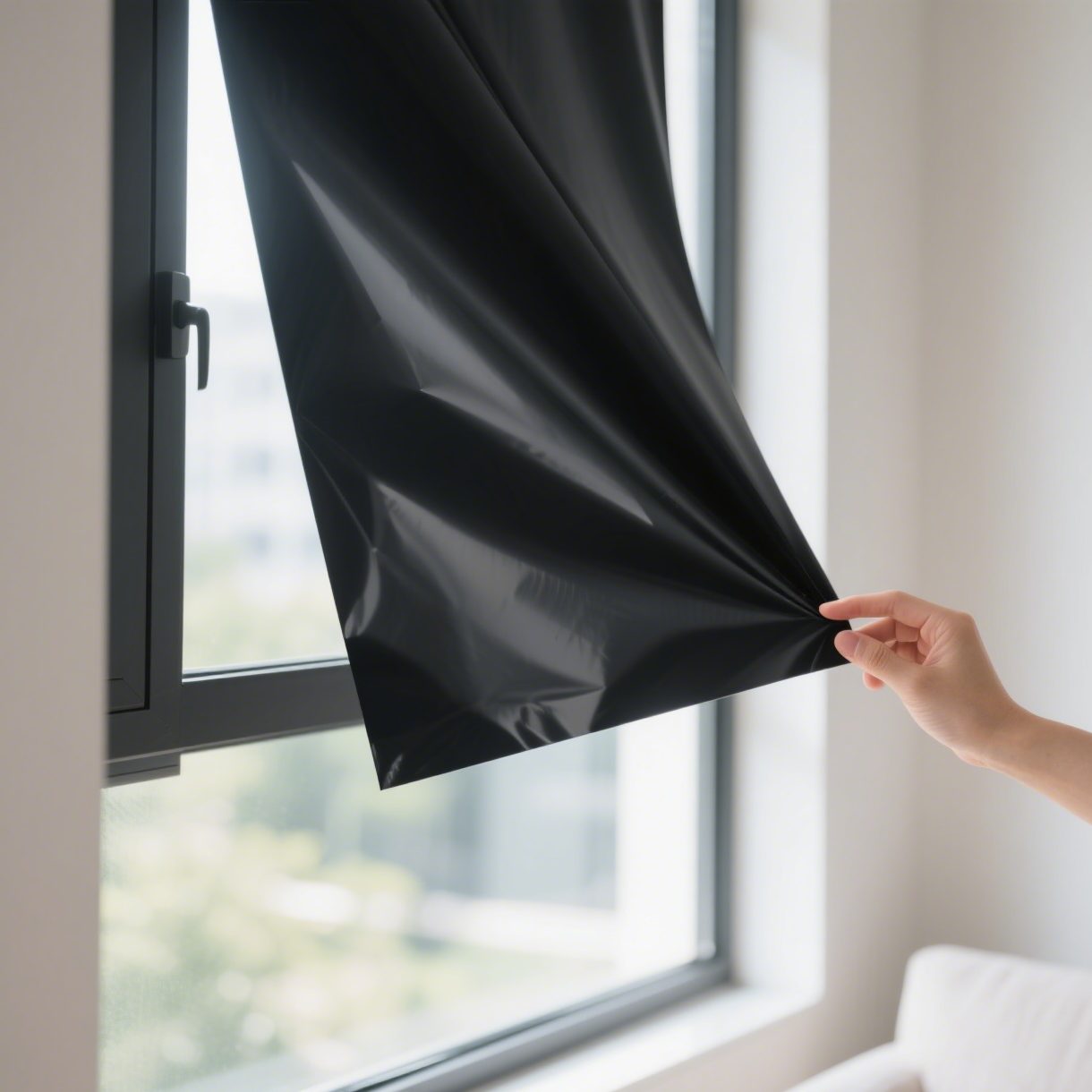
Classroom window blackout film is a light-control material that schools apply to glazing when glare, projector washout and afternoon heat start interfering with teaching. It matters because a classroom is a working space with a fixed timetable: a screen that cannot be read at 1 p.m. is not a cosmetic problem, it is a lesson that has to be delivered twice.
Most schools come to blackout film after trying everything else. They have bought blinds that break, curtains that trap dust, and portable projectors that were moved to a different room. What they actually need is a surface that behaves the same way every day of the school year, from the first lesson in September to the last week of June, without anyone thinking about it.
What Classroom Window Blackout Film Actually Has to Solve
A teaching room has three light problems that arrive at different times of day. Morning sun rakes across desks and hits the front wall, mid-day light washes out interactive panels, and late-afternoon sun comes in low from the side and lands directly on students' faces. A single roller blind handles one of those conditions well and the other two badly.
Film behaves differently because it changes the glazing itself rather than covering it. The light that enters is managed at the pane, so the room keeps its daylight and its view while the problem wavelengths are reduced. That is why schools in dense urban sites, where windows look onto a road or a courtyard, tend to prefer film to blinds: nobody can push it aside, and nobody has to maintain a mechanism.
Why Focus and Projector Legibility Point to the Same Specification
Teachers report the same sequence everywhere. First the screen becomes hard to read, so they dim the projector. Then the room goes half-dark and half the class stops taking notes. Then someone draws the curtains, the air turns stale, and attention drops again. The chain always starts at the glass, which is why fixing the glass is more effective than upgrading the projector.
- Contrast over darkness. A screen needs a controlled background more than it needs a black room, so partial, even control usually beats total blockage.
- Uniformity across the elevation. If one window is treated and the next is not, the eye reads the difference instantly and the room looks unfinished.
- Surface toughness. Classroom glazing is touched, leaned on and cleaned with whatever the caretaker has on the trolley.
- Safety behaviour. Film keeps glass fragments together if a pane is broken, which matters in rooms full of young people.
| Room Type | Typical Requirement | What Schools Get Wrong |
|---|---|---|
| General teaching rooms | Glare control with daylight retained | Choosing full blackout, then teaching in a cave |
| Science and computer labs | Screen legibility plus resistance to chemical cleaning | Standard film hazing after a term of aggressive wiping |
| Libraries and study areas | Even light distribution for reading | Treating it as an office, then losing the daylight feel |
| Auditoriums and halls | Deep blackout for staging and presentations | Forgetting perimeter gaps on high windows |
| Corridors and common areas | Heat reduction and durability against impact | Using the cheapest roll in the most abused location |
Reading this table against a real timetable is the fastest way to catch a specification mistake. A room that is only used for lectures has different needs from a room where a projector runs six periods a day, even when the windows are identical.
What a well-chosen classroom film changes over a school year:
• Screens that stay readable without darkening the whole room.
• No broken blind cords, no jammed rollers, no maintenance tickets.
• Fewer complaints about afternoon heat from the sun-facing side of the building.
• A consistent look across every classroom, not one room that was done as a trial.
Planning a School Roll-Out Without Disrupting Teaching
Education buyers work to a capital cycle, and the installation window is usually a holiday. That constraint shapes everything, from how the rolls are cut to how the panels are packed. A supplier who understands schools will cut to the window module rather than the stock roll width, so that installers spend their limited time applying film instead of trimming it.
- Survey every room orientation. North-facing rooms and south-facing rooms rarely need the same construction, and treating them identically wastes budget.
- Confirm the glass type with the facilities team. Coated and laminated glazing react differently, and the wrong adhesive choice shows up months later as edge lifting.
- Agree a cleaning protocol with the caretaking staff. Most premature failures are caused by cleaning products, not by the film itself.
- Stage the work by block. Finishing one building completely beats half-finishing three, because consistency is what parents and inspectors notice.
Where a school has a mix of old single glazing and newer units, it is usually worth treating both rather than only the worst. A partly treated elevation reads as a patchwork from the playground, and the untreated rooms keep generating the same complaints that started the project.
Sourcing Film for Education Projects
Public procurement asks for documentation, and rightly so. Education buyers should be able to see which standards a maker holds, who the manufacturer actually is, and whether the same roll will be available for the next phase. Zhejiang Huanlong has been manufacturing functional films since 2007 and holds OEKO-TEX® 100, Bluesign®, GRS, ISO 9001:2015, ISO 14001 and ISO 45001, which gives a school a verifiable compliance position instead of a brochure claim.
Because Huanlong runs three production bases in Zhejiang with blown film, extrusion and foaming lines, a district-wide programme can be produced to one recipe and supplied in phases. The light-control range is set out on the window blackout film page, and the broader construction and interior materials sit under film solutions.
The most useful thing a school can send is not a purchase order but a photograph of the worst classroom at the worst hour, together with the window dimensions. That one image removes most of the guesswork and prevents the expensive mistake of specifying a film for the wrong problem.
Comparing Film With Blinds, Screens and Curtains
Blinds, internal screens and blackout curtains all work the same way: they place something in front of the glass. That is also their weakness, because anything in front of a window has a mechanism, and a mechanism has a failure mode. In a school, that failure mode is usually discovered by a teacher at the start of a lesson, which means the room is out of service at exactly the wrong moment. Film changes nothing about how a room is used, which sounds like a small advantage until you multiply it by every classroom in a building.
Film also survives contact with students. It cannot be pulled down, wound up incorrectly, used as a goal post or left tangled at the end of term. For a facilities manager responsible for hundreds of windows, that removes a category of maintenance work rather than adding one. The trade-off is that the light level becomes fixed, so a room that needs both a bright setting and a fully dark setting will still want a curtain as a second layer.
Frequently Asked Questions About Classroom Window Blackout Film
Q1. Is classroom window blackout film safe on modern school glazing?
Modern coated units need a compatible adhesive, and that detail should be confirmed before ordering rather than after installation. Send your supplier the glass specification if you have it, or a close photograph of the pane edge if you do not, and ask them to confirm suitability in writing.
Q2. Can we install the film during term time?
It is possible in corridors and halls, but occupied classrooms are difficult because the glass has to be accessible, clean and undisturbed while the film sets. Most schools schedule the work into a half-term or summer break, and prefabricated panels cut to the window module make that window of time go further.
Q3. Will the rooms feel dark once the film is applied?
Only if the wrong product is chosen. Glare control and full blackout are different jobs, and most teaching rooms need the first. A brief demo on one window, viewed at the problematic hour, settles the question faster than any specification sheet.
Q4. How does the film handle a full year of cleaning?
It handles it well when the caretaking team knows what to avoid. Abrasive pads, solvent-heavy sprays and dry wiping over dust are the three habits that shorten a film's life, and a short written cleaning note issued at handover prevents most of them.
Q5. What does an education buyer need before requesting a quote?
Window dimensions, orientation, glass type and the number of rooms by type are enough to start. Zhejiang Huanlong works with schools and contractors as a film manufacturer rather than a reseller, so the specification can be matched to the building before the budget is committed.
A classroom is judged by whether teaching works inside it, and light is one of the few variables a school can still change without rebuilding. Get the orientation survey right, match the construction to the room type, and buy from a maker who will still be producing the same film when the next phase is funded. Handled that way, classroom window blackout film becomes invisible infrastructure that quietly supports every lesson.