
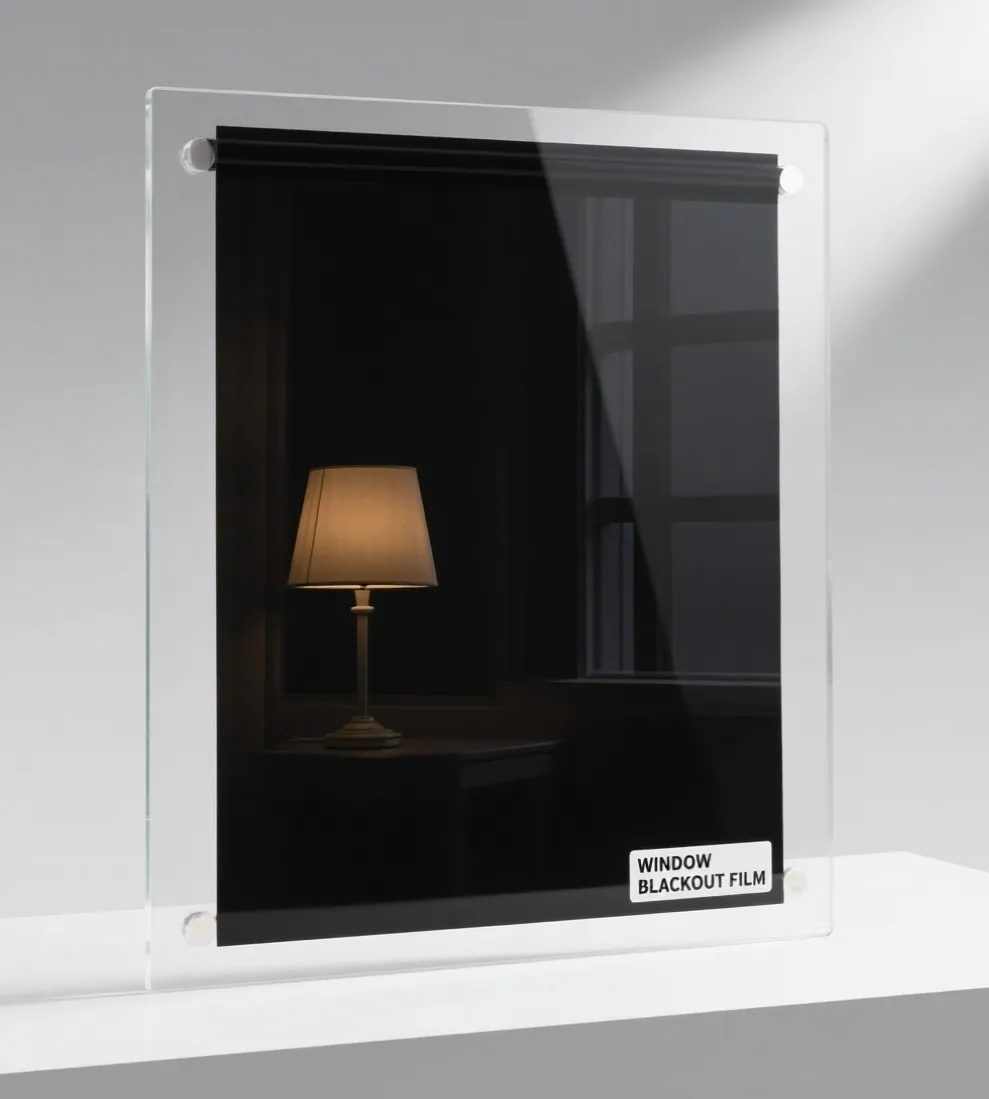
Window blackout film for hotels is a light-control material specified when guest rooms, banquet halls or lobbies must go fully dark without replacing the glazing. It matters because three decisions are made at the glass at the same time: how well a guest sleeps, how much cooling the building carries, and how often maintenance has to climb a ladder. A film that misses the darkness target or the durability target becomes a complaint file within one season, and no operations manager wants that.
In practice, hotels rarely buy blackout film as a decorative upgrade. They buy it because a specific room type is losing money: west-facing rooms that cook in summer, conference suites that cannot run a projector at 2 p.m., or heritage buildings where the original windows cannot be replaced. Understanding which of those problems you are actually solving is the difference between a film that lasts a decade and one that peels in eighteen months.
What Window Blackout Film for Hotels Has to Deliver
The performance envelope for hospitality is narrower than for residential use. A guest room has one window, one air handling unit and no curtain thick enough to rescue a bad specification, so the film carries the whole job. Three properties matter most: total light blockage measured as visible light transmission, dimensional stability under daily thermal cycling, and an adhesive system that releases cleanly if the property is later refurbished.
Hotels also care about what the film does to the exterior. A downtown property cannot afford a facade that turns patchy after two summers, and design review boards often reject dark reflective surfaces outright. That is one reason multi-layer constructions with a matte or neutral outboard surface keep winning specifications over the old mirror-look metallised films, which are efficient but visually loud.
Where Hotel Specifications Usually Go Wrong
- Specifying darkness without specifying heat. A film can block almost all visible light and still admit a large share of infrared energy, which leaves the room dark and uncomfortable.
- Ignoring the frame detail. Most leak complaints come from the perimeter, not the glass face, because a light gap at the reveal undoes the whole installation.
- Treating every zone the same. A ballroom and a guest bathroom have almost nothing in common in terms of cleaning chemistry or condensation.
- Buying on roll price alone. The installed cost is dominated by labour and downtime, so a cheaper roll that needs rework costs more in the end.
| Hotel Zone | Primary Requirement | Common Failure Mode |
|---|---|---|
| Guest rooms and suites | Total darkness at night, clean edges, quiet operation | Light bleed at the reveal; edge lifting after steam cleaning |
| Meeting and conference rooms | Even projection surface, no hot spots, fast reset between events | Patchy appearance where panels were replaced individually |
| Lobbies and atria | Glare reduction while keeping daylight and the exterior view | Over-darkening; colour shift visible against stone cladding |
| Banquet and event halls | Full blackout for staging, resistance to frequent handling | Scuffing and abrasion from staff and equipment movement |
| Back-of-house and offices | Solar heat control and screen readability | Adhesion loss on low-e glass without the correct primer |
Reading that table against a real property explains most of the arguments that happen during procurement. The same building can legitimately need four different constructions, and a supplier that quotes one SKU for all of them is telling you they have not walked the floors.
Why Sleep Quality and Cooling Load Point to the Same Material
Hotel revenue per available room is tied to review scores, and light control sits quietly inside those scores. Guests rarely write that a room had poor blackout performance, but they write that they woke at sunrise, and the rating follows. Operators who have tested blackout film against heavy drapery report the same pattern: the film removes the light, the curtain removes the last two percent, and the two together are cheaper than retrofitting motorised blinds across an entire wing.
Cooling follows the same logic. West and south glazing drives peak load in the late afternoon, exactly when occupancy and event demand collide. Because film is applied to the inside face, it does not change the building envelope or trigger planning consent, which is why it is often the only heat-control measure available to a listed facade or a leased floor plate.
What a well-specified hospitality film should quietly deliver:
• Guest rooms that stay dark through a summer sunrise without motorised hardware.
• Meeting floors that hold a consistent surface for projection at any hour.
• A facade that still reads as one building from the street five years later.
• A maintenance plan measured in cleaning cycles, not repairs.
Matching Film Construction to Each Zone of a Hotel
Construction choice comes down to how the film handles the energy it rejects and how it behaves in service. Multi-layer films with a robust surface layer resist the abrasive cleaning that housekeeping performs daily, while simpler constructions are adequate in back-of-house areas where nobody inspects the surface. The rule I apply when advising operators is simple: spend the extra layer where the film will be touched.
- Walk the site at the worst hour. Inspect the glazing at peak sun rather than at handover, because that is when complaints are generated.
- Record the glass type and the frame depth. Low-emissivity coatings and deep reveals change both the adhesive choice and the achievable darkness.
- Agree the darkness target in writing. Define it for the room as a whole, including the perimeter, not just for the glass panel.
- Plan the refurbishment exit. Specify a removable system if the property intends to replace glazing at the next capital cycle.
Roll width and panel layout matter more in hotels than in most other buildings, because guest room windows are narrow and repeated. A layout that minimises seams reduces both the visual risk and the number of places where a light gap can form, and it lowers the installer's time per room across several hundred identical units.
Custom Runs, OEM Programs and Supply Reliability
A hotel group rarely buys a catalogue product. It needs a consistent roll, a consistent colour, and the same material available for a second property eighteen months later. That is a manufacturing question rather than a trading one, and it is why we encourage buyers to visit the production line before they commit a group-wide specification. Zhejiang Huanlong operates three production bases in Zhejiang with blown film, extrusion and foaming lines, two R&D centres and more than thirty engineers, which is the infrastructure that makes repeat runs stable rather than approximate.
For hospitality projects the useful starting point is a defined application rather than a thickness. Tell a film manufacturer the glass type, the room type, the cleaning regime and the darkness target, and the construction can be matched to it. Huanlong's own light-control programme is documented on the window blackout film page, and the wider material set for construction and interior applications sits under film solutions.
Because we are a film maker rather than a distributor, specification conversations can happen early, at the drawing stage, before a property has locked itself into a glazing package it cannot change. That is usually where the largest savings sit, and it costs nothing to ask.
Frequently Asked Questions About Window Blackout Film for Hotels
Q1. Can window blackout film for hotels make a room completely dark?
The glass panel can be brought close to total blockage, but the room is only as dark as its weakest edge. Frame reveals, door gaps and ventilation louvres usually set the real limit, so we always ask for a photograph of the window at the worst hour before quoting.
Q2. Will blackout film damage the glazing if it has to be removed?
Removable systems exist for exactly this reason, and refurbishment planning should be part of the specification. The key variables are the adhesive family and how long the film has been in service, so tell your supplier the expected removal date rather than assuming the material is permanent.
Q3. Does one film work for guest rooms and for a ballroom?
Rarely. A ballroom is staged, handled and frequently reconfigured, so it needs a harder surface. A guest room is cleaned repeatedly with chemicals and left undisturbed, which is a different stress profile. Treating them as one line item is the fastest way to generate a patchy building.
Q4. How does the film affect the building's appearance from outside?
Neutral and matte outboard surfaces keep the facade consistent across a whole elevation, which matters when only part of a building is being treated. Highly reflective metallised constructions block more energy but create visible contrast, and many design reviews will reject them outright.
Q5. What should a hotel group ask a film manufacturer before ordering?
Ask for the construction behind each quoted roll, the certifications the maker actually holds, and whether the same material will still be produced when the second property starts. Zhejiang Huanlong has manufactured functional films since 2007 and holds OEKO-TEX® 100, Bluesign®, GRS and ISO 9001:2015 alongside ISO 14001 and ISO 45001, so a hospitality buyer can verify the compliance position rather than take it on trust.
Hotels do not get a second chance at a first impression, and light control is one of the few building decisions a guest experiences every single night. Specify it as an operational tool rather than a finish, verify the material at the worst hour of the day, and choose a maker who will still be producing the same roll when the next property is ready. That is how window blackout film for hotels stops being a line in a maintenance budget and starts working as part of the guest experience.