
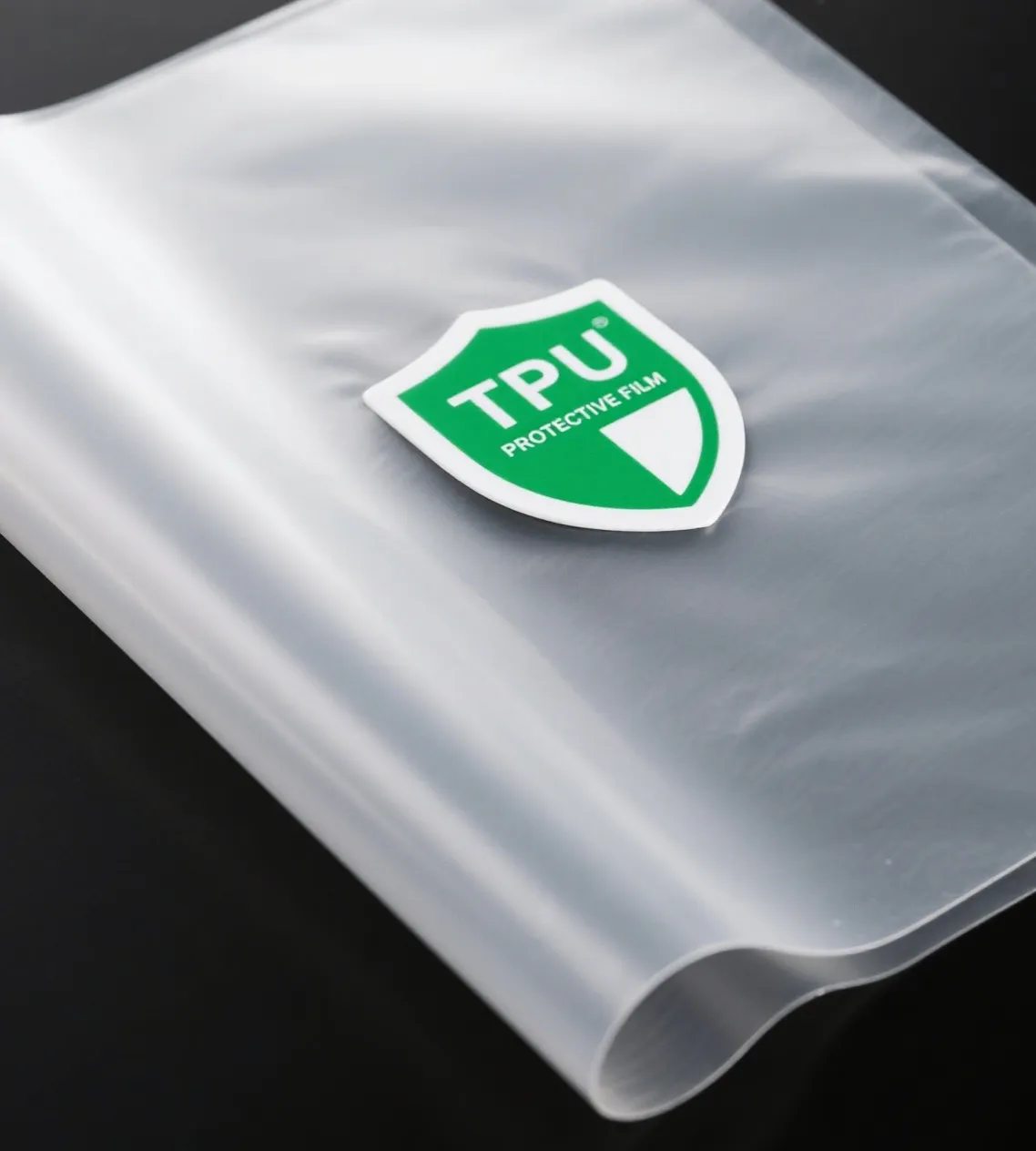
Recyclable TPU Film in Mono Material and Take Back Programmes
Design Rules, Sorting Reality and What a Take-Back Scheme Needs
Recyclable TPU film is technically achievable and commercially difficult, and the gap between those two statements is where most sustainability claims fail. A material can be recyclable and still never be recycled if nothing collects it.
TPU has one real advantage: it is thermoplastic and can be remelted, unlike crosslinked rubber or thermoset polyurethane.
This article covers what recyclability means in practice, the design decisions that determine whether a film can re-enter a stream, and the structure a take-back programme needs to work.
Recyclable Is Not the Same as Recycled Content
Recyclability describes whether a material can be processed back into a usable form. Recycled content describes how much recovered material is already in the product. They are separate claims and one does not imply the other.
A film can be 100 percent recyclable in theory and contain no recycled material, because no collection route exists for that product. It can also contain recycled content from a different waste stream while itself being difficult to recycle.
Certification schemes such as GRS cover recycled content in the supply chain, not the recyclability of the finished article. That distinction is frequently blurred in marketing material and should be checked in any specification.
For a buyer, the honest question is not whether the material is recyclable but whether a specific product, in a specific market, will actually enter a recycling stream and be processed.
Why Mono Material Decides Everything
A single-polymer construction can be reprocessed as one material. A multilayer construction of different polymers usually cannot, because the layers cannot be separated economically once bonded.
That is why a film laminated to polyester fabric, coated with an incompatible adhesive and printed with a crosslinked ink is effectively unrecyclable even if the TPU layer itself is perfectly recyclable.
Compatibilisers can help at low contamination levels, but they do not turn a mixed stream into a clean one. They extend the tolerance of a process rather than eliminating the need for sorting.
The practical design target is therefore a construction where every layer that remains attached is the same polymer family, or where the non-TPU components can be removed by the consumer before disposal.
The Mechanical Recycling Route
Mechanical recycling of TPU follows a predictable sequence: collection, sorting, size reduction, washing, drying, and re-pelletising. Each step imposes a constraint that the product design has to respect.
Sorting is the bottleneck. Near-infrared sorting relies on spectral signatures, and black or heavily pigmented film is difficult to identify. A product that cannot be sorted will not be recycled regardless of its chemistry.
Washing matters more for film than for rigid plastic because film has a high surface area and picks up contamination. Residual adhesive, print and mineral filler all reduce the quality of the recyclate.
Drying is critical for TPU specifically, because the material is hygroscopic and residual moisture causes hydrolysis during re-pelletising. A recycler without proper drying capacity will degrade the polymer rather than recycle it.
Design Rules That Keep the Option Open
Design for recycling is mostly about removing obstacles. Each obstacle removed increases the chance that the product is actually processed rather than landfilled.
- Keep the construction mono material, or make non-TPU components easy to detach
- Avoid adhesives that cannot be washed off, since they contaminate the recyclate
- Use pigments that sorting equipment can identify, or keep the film unpigmented
- Minimise mineral filler, which raises ash content and lowers recyclate value
- Design the print to be removable or keep it to a small area of the part
None of these rules is absolute. Each is a trade against cost, appearance or performance, and the right balance depends on whether recyclability is a regulatory requirement or a brand preference.
What Happens to the Properties
| Recycle pass | Typical change | Practical implication |
|---|---|---|
| First regrind | Small drop in molecular weight | Usually usable at a limited ratio |
| Second pass | Further reduction, colour drift | Downcycle into a less demanding part |
| Wet or undried regrind | Hydrolysis, gels and bubbles | Recyclate rejected or downgraded |
| Mixed polymer stream | Phase separation, weak interfaces | Only low-value applications |
| Filled or heavily printed | Ash content up, filter loading up | Recycler may refuse the batch |
Property loss is not linear and it is not reversible. Each pass shortens the polymer chains, and the effect accelerates once the molecular weight drops below the range where the hard and soft segments still phase separate effectively.
Chemical Recycling and What It Changes
Chemical recycling breaks the polymer back into monomers or oligomers and rebuilds it, which avoids the molecular weight loss of mechanical recycling. For polyurethane chemistry the routes are glycolysis and related solvolysis processes.
That sounds like a complete answer, and it is not. Chemical recycling needs a concentrated, clean feedstock, significant energy and a facility within transport distance, so the economics only work at scale.
The practical consequence for a product designer is that chemical recycling is not a licence to ignore mono material design. A mixed or heavily contaminated stream is just as unwelcome to a chemical process as to a mechanical one.
Where the process is available, it is usually applied to production scrap and pre-consumer waste rather than to post-consumer film, because those streams are already identified and clean.
Treat chemical recycling as an additional route rather than a replacement. Mechanical recycling is the lower-energy option wherever the material quality allows it, and it remains the first choice for a clean mono material stream.
Traceability matters for both routes. A recycler needs to know what is in the bale, and a product with an unmarked additive package or an unidentified laminate layer will be rejected before it reaches the process.
Making a Take-Back Programme Work
A take-back programme needs three things that have nothing to do with polymer chemistry: a collection point the customer will use, a logistics route back to a processor, and a specification for what the returned material can become.
Collection rates decide whether the scheme is viable. A programme that recovers a small fraction of the volume it sells is a communication exercise, not a recycling route.
The simplest programmes target a single product family with known composition and a known return flow. Industrial scrap from a converting line is far easier to recycle than post-consumer film, because the material is clean, identified and available in quantity.
Starting with production scrap is the pragmatic route. It validates the processing step, establishes the quality of the recyclate and builds the evidence needed before a consumer-facing scheme is attempted.
Where Recyclability Claims Fail
- Claiming recyclability for a construction that cannot be separated into one polymer
- Ignoring whether local sorting equipment can identify the material
- Confusing GRS recycled content with end-of-life recyclability
- Assuming a laboratory trial proves a commercial collection route exists
- Quoting a recyclate ratio the material cannot actually tolerate in production
The programme structure for film applications is set out on the film solutions page, which shows how a mono material approach is applied across product families.
Zhejiang Huanlong New Material Science Technology Co.,Ltd produces TPU film on 44 lines across three manufacturing bases, with two R&D centres and more than 30 engineers. Huanlong holds GRS certification alongside ISO 9001:2015, ISO 14001 and ISO 45001, and can discuss mono material constructions for recyclable TPU film projects.
The short version: recyclable is a design property and recycled is a supply chain property. Keep the construction mono material, make it sortable, keep it dry at reprocessing, and start the take-back route with production scrap.
A recyclable film that nobody collects is still waste.
Frequently Asked Questions About Recyclable TPU Film
Is TPU film recyclable?
Yes in principle, because it is thermoplastic and can be remelted. Whether a specific product is recycled depends on the construction, the sorting infrastructure and whether a collection route exists.
What is a mono material laminate?
A construction where all bonded layers belong to the same polymer family, so the whole assembly can be reprocessed together. It usually requires a TPU adhesive and a TPU carrier instead of conventional alternatives.
How many times can TPU be recycled?
It depends on the grade and the process. Each pass reduces molecular weight, so there is a practical limit; in most cases the material is downcycled into less demanding applications rather than returned to the original use.
Does GRS mean the film is recyclable?
No. GRS certifies recycled content in the supply chain. It says nothing about whether the finished article can be recycled at end of life, which is a separate question.
What is the biggest barrier to recycling TPU film?
Collection and sorting, not the polymer itself. Film is light, often contaminated and frequently laminated to other materials, all of which make it harder to recover than rigid plastic.
Send the product construction, the volume and the intended collection route, and the recyclable TPU film options can be assessed against it. Huanlong can advise on mono material constructions and recycled content availability.
See How the Film Is Made Ask About Recyclable TPU Film